The ADHD Exchange: Classroom Management: ADHD Behavior Management
Presented by Nicole Stewart
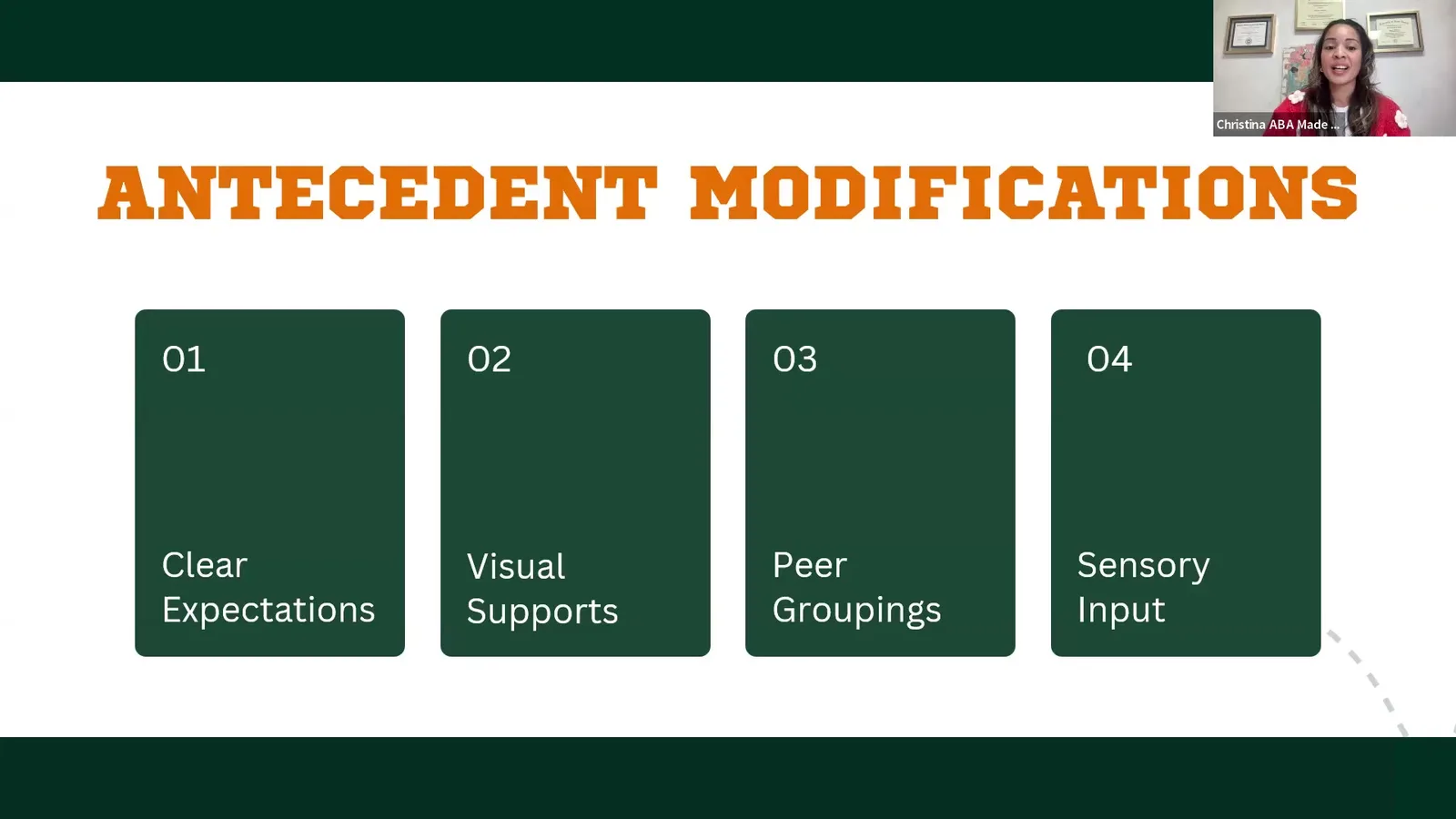
Classroom behavior in students with ADHD often has roots that a function-based approach alone can miss. This training for BCBAs looks at common classroom behaviors, gender differences in how ADHD and disruptive behavior present, and a case study that shows how underlying learning challenges, emotional regulation, and executive functioning deficits can drive what appears on ABC data. Participants explore how to advocate for students with both parents and school teams, using relationship building, data, and the process of ruling out medical and biological needs. When an underlying issue is not the cause, the training covers pairing, antecedent modifications such as clear expectations, peer groupings, visual supports, and sensory input, self-advocacy boards, collaborative goal setting for skill deficits, and thoughtful consequence planning. The training closes with strategies for consistent, data-based communication with families.
Sign in to buy — $17One-time purchase, permanent access. Cert delivered to your inbox the moment you pass the quiz.
About this CEU
Classroom behavior in students with ADHD often has roots that a function-based approach alone can miss. This training for BCBAs looks at common classroom behaviors, gender differences in how ADHD and disruptive behavior present, and a case study that shows how underlying learning challenges, emotional regulation, and executive functioning deficits can drive what appears on ABC data. Participants explore how to advocate for students with both parents and school teams, using relationship building, data, and the process of ruling out medical and biological needs. When an underlying issue is not the cause, the training covers pairing, antecedent modifications such as clear expectations, peer groupings, visual supports, and sensory input, self-advocacy boards, collaborative goal setting for skill deficits, and thoughtful consequence planning. The training closes with strategies for consistent, data-based communication with families.
Credits
1.5 CEUs · 78 min
From the talk
What was covered
Nicole Stewart looks past surface behavior to find what drives it in ADHD classrooms. She covers reading disorders, gender differences, building relationships, classroom changes, and advocating for students.
- Before you write a plan, look at the behavior's function (why it happens). Then check for an unidentified learning problem driving it.
- Screen every student with ADHD for a reading disorder, since Stewart reported a 50 percent overlap in both directions.
- Watch quiet, non-disruptive girls for masking (hiding symptoms to fit in) and anxiety. Also watch for relational aggression (conflict through friendships), instead of waiting for a chair to fly.
- Make a positive relationship with the adult your first antecedent change (something you adjust before behavior happens). Then add written expectations, peer grouping, and sensory supports.
- Build self-advocacy boards so a flooded child can point instead of searching for words.
- Ask teachers for one small change and a once-a-month form, and tell them where that small change is headed.
Why ABC Data on a Student With ADHD Can Point You at the Wrong Problem
Nicole Stewart built the talk around a real case. A first grader sat in a general education class with no IEP (a legal school services plan). His meltdowns included throwing items, dumping materials, and refusing work. He went from zero to sixty fast. His mother kept getting emails about everyone's safety.
Then Stewart showed three rows of ABC data (what happens before and after). The antecedents were a teacher's compliment, a move to tabletop work, and homework that looked different from everyone else's. The behavior was throwing materials. The consequences were a walk with the social worker and adult prompting. He also got glue sticks so his page matched the rest of the class.
Read that strictly for function. You get escape (getting out of a hard task) plus attention (getting adult time and focus). Stewart agreed both were there. A token economy (earning points toward a reward) or a visual schedule would likely drop the count. She does not call those plans bad. She calls them incomplete.
Her read on this child was a biological overreaction to stress. His body floods when anything feels hard or unexpected. A plan that withholds the walk may stop you from reinforcing the flooding. It still does not teach him to handle stress. And the demands he escapes may be demands he cannot meet yet.
The problem is it's not addressing the underlying cause of the behavior.
From the talk — Nicole Stewart
Which Classroom Behaviors Show Up, and Which Ones Get Missed
Stewart's working list of classroom problem behaviors was broad. Task avoidance. Class clown jokes and making fun of other kids. Interrupting. Refusals. Environmental destruction. Full tantrums. Bullying. A live participant added one that was not on the slide. It was the student who cannot sit still, misses teacher questions, and jumps off topic mid-conversation.
Stewart flagged that addition as a strong example. That pattern does not derail the room. It derails the learner. Nobody calls a meeting about it, so it can go unaddressed for a long time. The same thing happens to the student who simply is not paying attention. No disruption does not mean no problem.
Bullying got its own warning. The word gets thrown around in schools in ways that do not match real bullying. Then when a child actually is bullying, it gets waved off as a kid who is not very nice. Stewart framed it as a symptom instead. It can come from social rejection, feeling othered, or a way to cope with hard feelings.
I feel like we still we still attribute a lot of personality defects to problem behavior
From the talk — Nicole Stewart
How ADHD and Disruptive Behavior Present Differently in Girls
Stewart noted up front that gender is a spectrum. These patterns are phenotypes (a common pattern of traits), not fixed rules. Hormones differ. Socialization differs. So the behavior looks different at school. Stewart cited one to three percent of girls and five to ten percent of boys showing disruptive behavior in classrooms. When girls do get disruptive, she said it is often more severe.
Girls also carry more co-occurring diagnoses (more than one condition at once). Anxiety. Depression. Outpatient therapy. A higher chance of eating disorders. The disruptive behavior tends to come out later. It hides behind those other labels, which is often how the ADHD diagnosis gets missed. Aggression also looks different. It runs through friendships: gossip, talking badly about other kids, and the you are not my best friend anymore cycle.
The research Stewart read tied girls' disruptive behavior more closely to home environment than boys' behavior. Her explanation was behavioral contrast (acting different across two settings). Many girls hold it together at school and let go at home. When home is chaotic and offers no safe place to fall apart, that strategy breaks down. She is less able to hold it together all day, so school is where the behavior shows up instead.
That makes self-advocacy a real goal, not a nice extra. Stewart described boys being sent to the bathroom to count and calm down. The girls in the same room were never offered that option. Those students need to learn to raise a hand and ask for the break themselves. Masking (hiding symptoms to fit in) is the thing you are trying to prevent.
So only one to 3% of girls will have disruptive behavior in classroom settings.
From the talk — Nicole Stewart
Reading Disorders and ADHD: The Comorbidity to Rule Out First
Stewart came back from an ADHD summit talk on early reading intervention with a number that drives practice. A child with ADHD has about a 50 percent chance of also having a reading disorder. The overlap runs both ways. She called this a comorbidity (two conditions in the same person) we should be screening for and usually are not.
She also described two findings on reading and behavior. One study she cited was done in Thailand in 2022. It included roughly 200 children with ADHD and about 750 without a diagnosis. Children with a reading disorder showed more emotional problems, conduct problems, hyperactivity, and peer problems, at a statistically significant level. In other work, being a poor reader in first grade predicted problem behavior by third grade. It also went the other direction: poor task engagement in first grade predicted a lower reading level by third.
First grade is where this gets hard to catch. Two grade levels below a first grader is preschool, so the usual eligibility metric does not exist yet. Stewart's yellow flag is a mismatch. Math is fine. Social studies is fine. Listening comprehension is fine. Reading is still stuck on letter sounds.
Writing gives you flags too. Capital and lowercase letters mixed together past the early grades. Letter size all over the place. No ability to stay on the line. Spelling that does not match the sounds. Behavior analysts do not diagnose or treat dyslexia (a reading-based learning disorder) or dysgraphia (a writing-based learning disorder). Recognizing the signs and routing the child to the right evaluation is still squarely our job.
If they are diagnosed with a reading disorder, there is a 50% chance that they have ADHD.
From the talk — Nicole Stewart
Skill Deficit, Will Deficit, and the Gifted Learner Nobody Planned For
The question to ask about any refusal is simple. Does the child have the skill to do this task, or does the child lack motivation? If it is a skill problem, you can cut response effort (how much work a task takes). Fewer problems on the page. Typing instead of writing. Functional communication training (teaching words that replace behavior) can help. The child learns to say I do not understand or I need more help.
Teachers often push back. They say the student has to do all the problems, or that there is no IEP allowing a change. Stewart's answer is about direction, not permission. A child who can tolerate one problem gets one problem today. The terminal behavior (the final goal you want) is the full worksheet or thirty minutes of instruction. You shape toward it from where the child actually is.
Fairness is the other objection. If one child does one problem, fifteen parents hear about it. Stewart's position is that need drives the decision. A child who can handle ten questions should be asked to handle ten questions.
Giftedness lands in the same bucket from a different side. A gifted learner may absorb in twenty minutes what the class spends a week on. Then that child fills the rest of the day with behavior. Stewart treats that as an underlying learning difference too, just not a deficit. Consider assessing for giftedness and pursuing enrichment outside the classroom. Do real work on acceptance, because school will not meet that child's needs completely.
I personally think you have to have an attitude of everybody gets what they need.
From the talk — Nicole Stewart
Pairing and Antecedent Changes That Reduce Classroom Problem Behavior
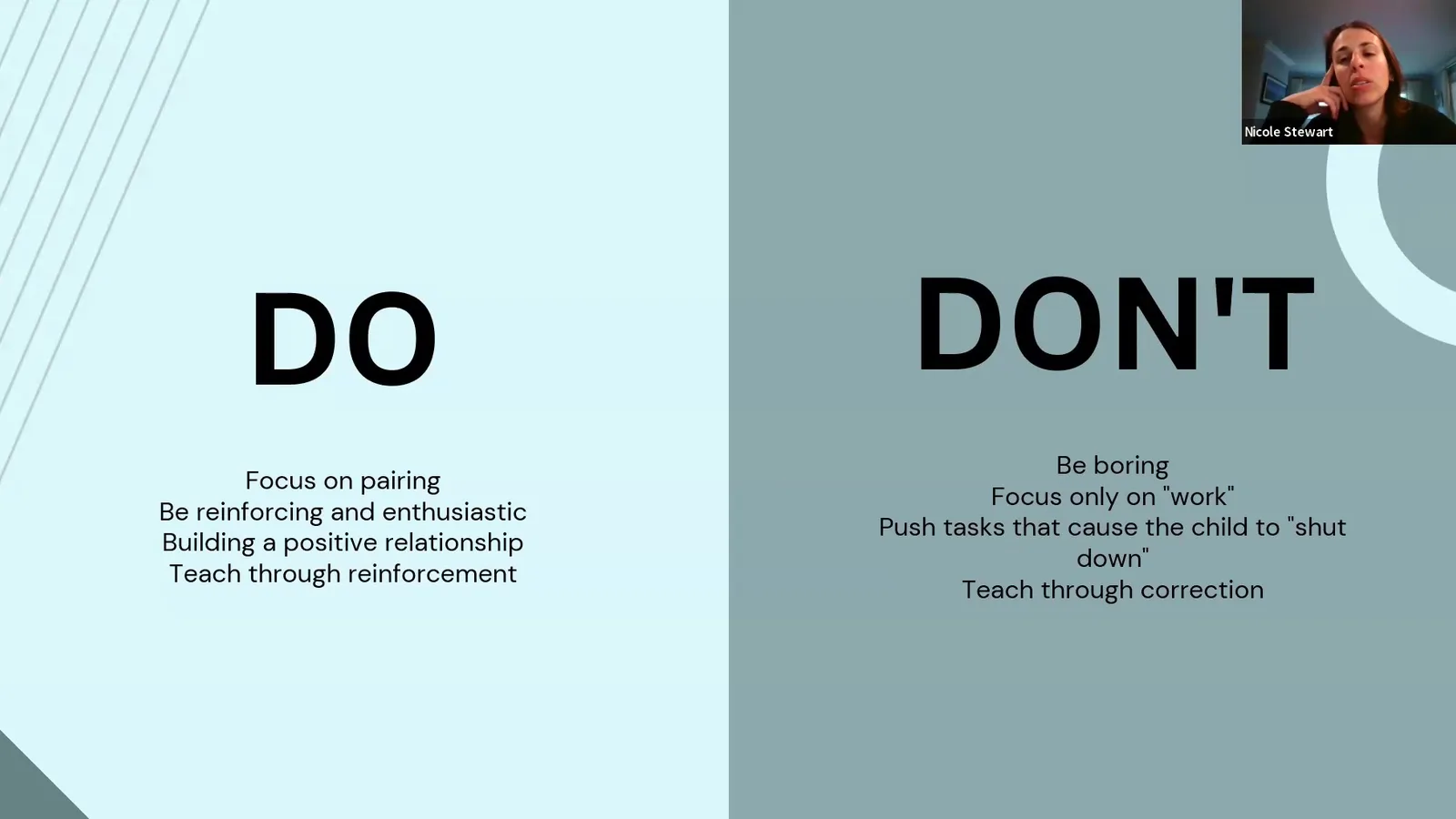
When no underlying issue explains the behavior, Stewart starts with the relationship. Pairing (building yourself up as rewarding) is the first antecedent modification (changing things before behavior happens). A child who is intrinsically motivated (driven by internal reward) by the teacher is easier to redirect. Corrections land as support instead of one more piece of negative feedback. Students with ADHD, she noted, hear five to nine times as many negative comments about themselves as their peers do.
In practice that means brief check-ins. One at the start of the day, one at the end. A private signal between teacher and student. Praise that names the real thing: today you sat for twenty minutes, yesterday it was fifteen. A general education teacher cannot do this with twenty students. Four students need it daily, and as the relationship holds, you fade to every other day.
Then make the expectations crystal clear and write them down. Students with ADHD often struggle with working memory (holding information in your head), so verbal rules evaporate quickly. Include what happens if the rule gets broken, not just the rule. Break vague language down: what does a quiet voice mean, and when exactly do listening ears need to be on? A written expectation takes the control battle out of it, because the paper is not a person to argue with.
Two more antecedent changes close the set. Peer grouping is a real variable. Decide which peers bring out prosocial behavior (behavior that helps others) and which ones do not. You can limit one pairing in one setting without ending the friendship. Meet sensory needs on purpose with wobble seats, fidgets, and gum. Gum gives steady oral motor feedback (movement and sensation in the mouth).
So the number one antecedent modification for problem behavior is establishing a positive relationship.
From the talk — Nicole Stewart
Self-Advocacy Boards and Collaborative Goals for Skill Deficits
Stewart prefers the term self-advocacy board over choice board or communication board. The reasoning is in the name: it teaches a child that their voice has power. Pulling language out of thin air during a meltdown is very hard. A prompt to take a deep breath often triggers more opposition instead. A board on the table lowers the effort to ask for what you need.
She builds them with picture symbols and has the child cut them out. The child decides the format: a small book, an index card, a poster. Laminate it. In one example, she set the board down during a rising moment. She opened a drawer with gum in it and walked away. The child picked gum and settled without a single instruction. Ten minutes later she named what happened, out loud, as a win.
For skill deficits, she uses an assessment of skills and unsolved problems, a tool she credited to Ross Greene. You check off the skills the child struggles with. Maintaining focus. Regulating emotional responses to problems and frustration. Empathizing with others. Tolerating the sensory environment. Understanding what others communicate. Regulating activity level. The point is to define the problem correctly before trying to solve it.
She pairs that with a short teacher rating form. It covers group skills, social skills, executive functioning (planning, starting, and organizing skills), self-control, and advocacy. The rating key borrows report card language, because teachers already know how to use it. It is not a perfect operational definition (an exact, measurable description). It ranks which problem is biggest for this child, which is what she needs. Goal setting then happens with the student: self-awareness and self-advocacy first, then regulation, flexibility, organization, time management, and social skills.
Make it super easy for them to tell you what they want in those moments.
From the talk — Nicole Stewart
Consequence Planning, School Advocacy, and Family Communication
Consequence planning starts with choosing your battles. Pick one scenario, not one behavior. Returning from recess, for example, becomes a routine. Go to your backpack. Get a drink of water. Give me five high fives. Then use the calm corner if you want. Ask which lift is easiest and which will change the room the most.
If punishment procedures (consequences meant to lower behavior) are in play, save them for unsafe behavior. That means aggression, property destruction, and thrown chairs. Those limits need to be clear and known in advance. Watch the escape loop, though. If throwing a chair cancels the test, the plan backfires. The test still gets taken, just later or somewhere else. For safe but disruptive behavior, model the language. Keep the board out. Offer a calm space and flexible seating. Give a real way to leave a task and come back.
Advocacy follows the same logic. Push the team to rule out medical and biological causes, and document thoroughly. With a resistant teacher, ask for something tiny: two check-ins a day, or a new seat partner. Then be transparent. The small ask is a starting point, not the finish line. Let administrators know where you are headed.
Family communication should be consistent and data based. A daily log or report card works, especially when the student helps fill it out. Quantify where you can, even with happy, medium, and sad faces. Always include something positive. You cannot control what happens at home. A day of only bad news can mean the child loses privileges on top of a hard day.
Start with small things, especially with teachers who might be resistant.
From the talk — Nicole Stewart
Common questions
Why isn't a function-based approach enough for ADHD classroom behavior?▾
A function-based plan can be right about the payoff and still miss the cause. Stewart's case showed clear escape and attention. But the child was also flooding under stress, and possibly struggling to read and write. Removing reinforcement for the flooding does not teach the child to handle stress or close a learning gap.
How often do ADHD and reading disorders occur together?▾
Stewart reported roughly 50 percent in both directions. Half of children diagnosed with ADHD have a reading disorder. Half of children diagnosed with a reading disorder have ADHD. That overlap is high enough that reading should be screened before behavior is treated as the whole story.
What are early signs of a reading or writing problem a BCBA (board certified behavior analyst) can notice?▾
Look for a mismatch between reading and everything else. Math is strong. Comprehension is strong when someone reads aloud. But reading stays stuck on letter sounds. In writing, watch for mixed capital and lowercase letters. Watch for irregular letter size and trouble staying on the line. Watch for spelling that does not match the sounds. You cannot diagnose or treat these, but you can push for an evaluation.
Does ADHD look different in girls at school?▾
Stewart cited one to three percent of girls showing disruptive behavior in class. For boys, the rate was five to ten percent. When girls were disruptive, it tended to be more severe. Girls carry more co-occurring anxiety, depression, and eating disorders, and aggression often runs through friendships instead of the room.
What should you ask a teacher to do first?▾
Ask for the smallest change you think they will actually do. Two brief check-ins a day or a seating change are good starting points. Stewart also recommends a once-a-month rating form rather than daily data collection. A form that gets filled out beats a perfect one that does not.
About the speaker
Nicole Stewart is a behavior analyst and a certified special education teacher based in New Jersey. She has worked in special education for almost 20 years, across a wide range of diagnoses. She was previously clinical director of a multidisciplinary clinic (a clinic with several types of specialists) in Manhattan. She now runs her own private practice. About half of her caseload is students with ADHD, anxiety, or no diagnosis yet. She also speaks as the parent of a child with ADHD. Much of this talk draws on school advocacy she has done for students in general education (regular classroom) settings.
This summary was generated from the recording’s transcript. Quotes are taken word for word from the talk.
What you'll learn
- 11. Analyze ABC data for learning, emotional, and executive functioning factors behind classroom behavior. 2. Design antecedent modifications and consequence plans that reduce classroom problem behavior. 3. Present data to families and school teams to support a hypothesis and rule out medical causes.
Related talks
Talks that cover the same concepts
The ADHD Exchange: Best Practices
ABA Made Ez
The ADHD Exchange: Teaching Emotional Regulation
ABA Made Ez

The ADHD Exchange: Social Skills: Performance or Skill Deficit?
ABA Made Ez
The ADHD Exchange: Understanding the Neurobiology of ADHD
ABA Made Ez
The ADHD Exchange: Executive Functioning
ABA Made Ez
OpenCEU is supported by advertising from third-party sponsors. Sponsors are clearly labeled, have no influence over course content, instructors, or CEU decisions, and never appear on certificates. The BACB does not sponsor, approve, or endorse OpenCEU sponsors or their products.