The ADHD Exchange: Social Skills: Performance or Skill Deficit?
Presented by Nicole Stewart
Many children with ADHD know the social skills they need but struggle to use them in real situations. This training for BCBAs reviews research on social skills deficits in ADHD, including findings on declining social motivation and rising social anxiety in adolescence, and research showing that performance deficits, more than skill deficits, are the primary challenge for this population. Participants learn how to determine which type of deficit is present and how to respond to each. For skill deficits, the training covers observation, task analysis, 1:1 teaching, and the “social spy” approach for building awareness in natural settings. For performance deficits, it examines three underlying mechanisms, working memory, impulse control, and emotional regulation, with targeted strategies for each, including mindfulness practices supported by research with adolescents. The training closes with the role of self-acceptance as a behavioral cusp and social safety net.
Sign in to buy — $17One-time purchase, permanent access. Cert delivered to your inbox the moment you pass the quiz.
About this CEU
Many children with ADHD know the social skills they need but struggle to use them in real situations. This training for BCBAs reviews research on social skills deficits in ADHD, including findings on declining social motivation and rising social anxiety in adolescence, and research showing that performance deficits, more than skill deficits, are the primary challenge for this population. Participants learn how to determine which type of deficit is present and how to respond to each. For skill deficits, the training covers observation, task analysis, 1:1 teaching, and the “social spy” approach for building awareness in natural settings. For performance deficits, it examines three underlying mechanisms, working memory, impulse control, and emotional regulation, with targeted strategies for each, including mindfulness practices supported by research with adolescents. The training closes with the role of self-acceptance as a behavioral cusp and social safety net.
Credits
1.5 CEUs · 83 min
From the talk
What was covered
Many kids with ADHD know the social skills and still cannot use them. How to tell a skill deficit (not knowing the skill) from a performance deficit (knowing it but not using it). What to do about each.
- Rule out a skill gap first, then plan for a performance problem. A study of 70 kids ages 8 to 12 tied ADHD to performance ratings, not to trouble learning new skills.
- When a teacher says "I know he can do better," treat that as proof the expectation alone is not working. Ask what support closes the gap in the moment.
- Teach the social spy routine so a child learns to watch people on purpose. That opens up learning you never have to teach directly.
- Train working memory (the brain's short-term workspace) in session. Use number recall games, silly sentence games, and a daily "what four things did we do today" question.
- Aim for toleration with mindfulness first. Then build breathing into freeze dance, drawing games, and parroting before you use it during a real trigger.
- Break self-acceptance into teachable parts: naming limits, asking questions, asking for help, and seeking feedback from people the child trusts.
Why ADHD social skills are a safety issue, not a polish issue
Parents bring the same worries to a first meeting. Why does my child have no friends? Other kids get birthday invites, so why not mine? Why is my child the only one running around at soccer? Is my child too much for other kids? Some parents also see their own childhood in their child. They struggled socially, and they fear the same path.
Part of our job is grounding those worries. Some of what parents see is normal for the age. Some of it is just the tip of the iceberg. The soccer meltdown may only mean soccer was the wrong class. The other kids in that class have their own hard moments at home. Parents only see the parts that happen in public.
One piece of this is more than worry. Research has shown that an ADHD diagnosis is linked to higher risk of negative life experiences. That list includes depression, job trouble, unemployment, addiction, and drug or alcohol misuse. A supportive community acts as a protective factor (something that lowers those risks). So this work is not about social polish. It is about helping a child build a social safety net.
That also sets the goal. We are not building a neurotypical mask (acting like a non-ADHD kid). We are not teaching a child to fake interest in things they hate.
My goal is to understand what the child is looking for out of their social network
From the talk — Nicole Stewart
Falling social motivation and rising social anxiety in the teen years
A new study framed the problem well. Martin McCain Kirk surveyed 204 parents of children and adolescents with ADHD. In the teen group, social motivation (the drive to be around other people) went down. Social anxiety (fear of social situations) went up. The two moved in opposite directions. The same pattern did not show up in the younger children. Something builds between childhood and adolescence.
The authors concluded there is a lack of application of learned social skills in real world situations. Kids are not short on chances to learn the skills. They learn them and then do not use them where it counts. For those of us who work one to one, that stings. The skill shows up in session. It falls apart at lunch and recess. Parents tell me the same thing: class is fine, recess is a mess.
The same work noted that kids with ADHD face more chronic rejection than peers. An earlier session in this series touched on this too. Kids with ADHD may face about four times as much daily criticism as other kids do. The ADHD brain is also wired to react more strongly to negative interactions. This is known as rejection dysphoria (rejection that hurts much harder). Now picture the loop. Rejection leads to fewer social attempts. Fewer attempts mean fewer chances to learn. Less contact with positive reinforcement (good outcomes that follow trying) means even less reason to try again.
One fix sits in the setting, not in the child. Help families find peers who feed a child's energy instead of draining it. Kids who shrug off a mistake keep a child willing to come back and try again. Two real friendships do more than a class-wide invite list.
it's better to be invited to one birthday party that's a sleepover with three kids than it is to be invited to every single birthday party because you're invited to the whole class
From the talk — Nicole Stewart
Skill deficit or performance deficit: what the 2018 study found
Aduan and colleagues ran a 2018 study on this exact question. They looked at 70 children, ages 8 to 12, with close to even numbers of kids with and without ADHD. They used assessment data plus rating scales from parents and teachers. Then they coded the results for two things. One was acquisition deficits (the skill was never learned). The other was performance deficits (the skill is known but not used).
Neither group had trouble learning new social skills. The skills themselves were not the gap. Kids with ADHD were more likely to be rated as having performance deficits. They were also less likely to be scored with strengths.
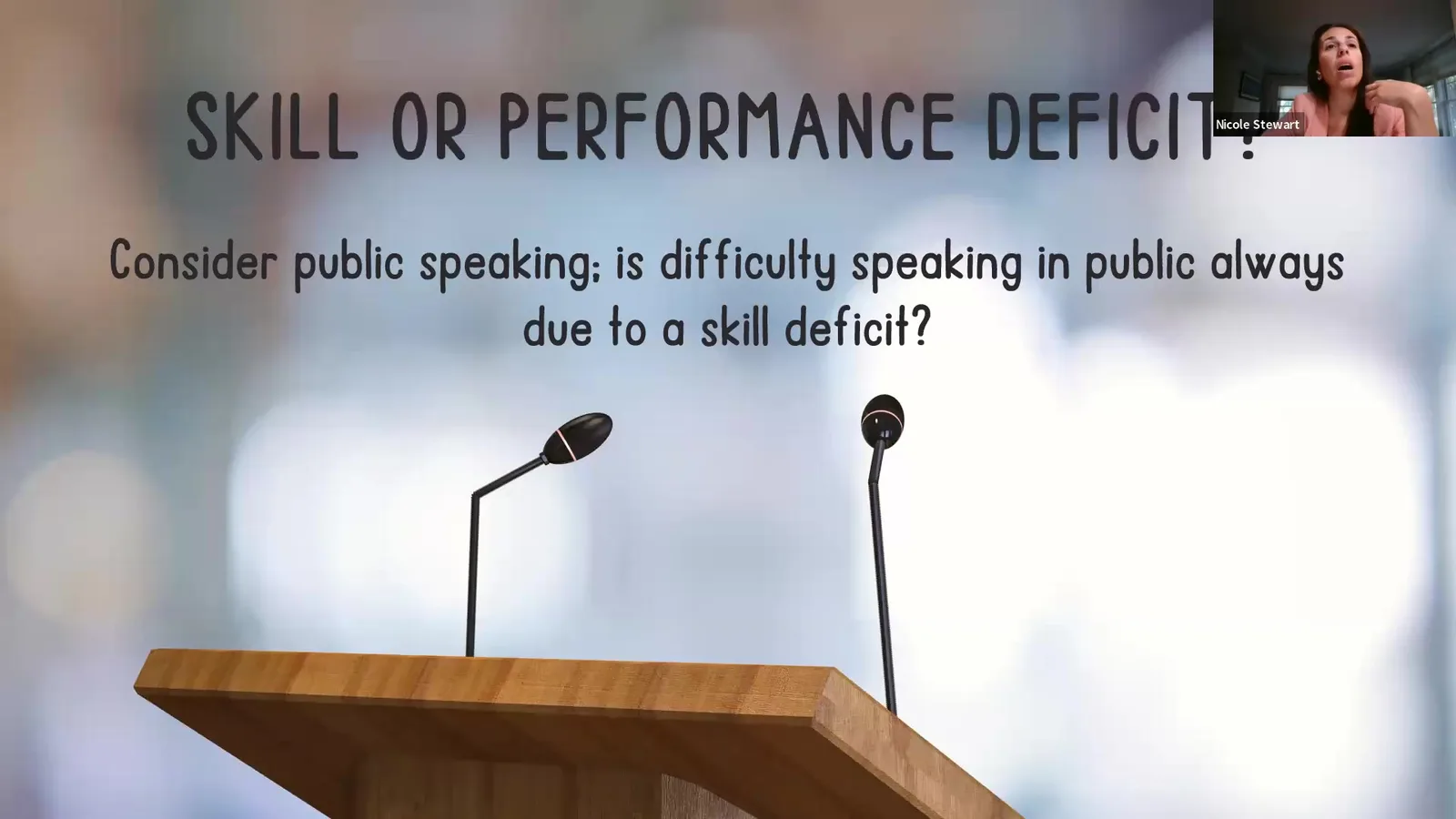
Public speaking makes this easy to feel. Say you rehearse a speech for weeks. You know the words, the hand gestures, the pace, how often to look up. You can still stand up and freeze. You stumble, you stare at your paper, you talk too fast. Nobody calls that a skill deficit. This is also the answer to a line we hear from school staff: I know he can do better. Often true. He is still not doing it. Expecting the skill to show up has already failed.
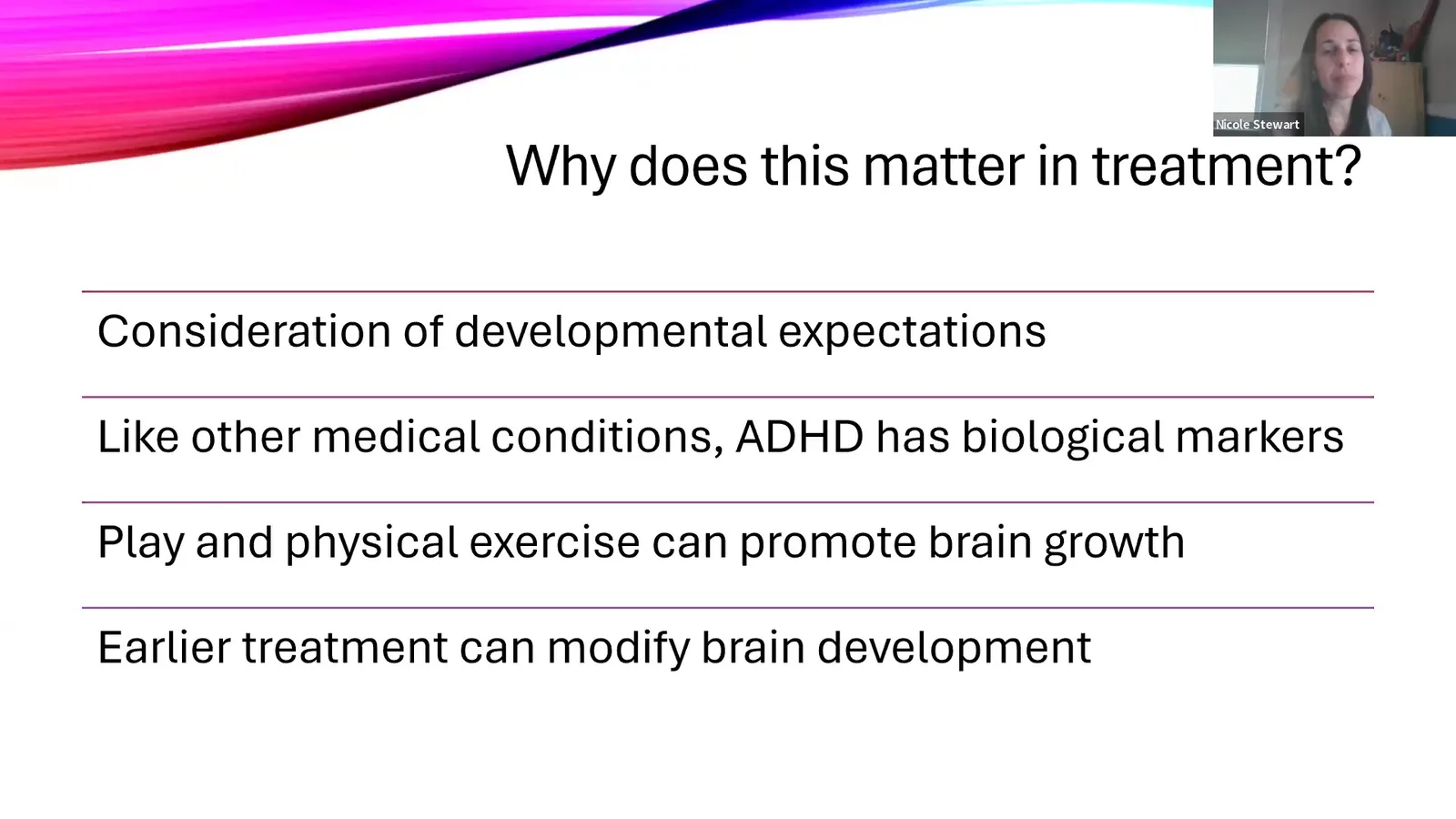
There is a biological reason for the gap. The ADHD brain has different levels of neurotransmitters (brain chemicals that carry signals), so it develops differently. The prefrontal cortex (the front part of the brain) is underdeveloped, and that is where working memory lives. The basal ganglia (a deep brain area tied to habits) has less white matter, which means lower impulse control. It works like diabetes and insulin. It is not the child's fault and it is not bad. It is how the brain is built.
people with adhd know what they're supposed to do but whether or not they can perform the skill in the moment is a completely different story
From the talk — Nicole Stewart
How to check for a real skill gap and teach it in small units
Performance problems are more common, but skill gaps are real. Kids who are mainly inattentive (less visible hyperactivity) are the most likely to have them. A child living inside their own head misses what is happening around them. They lose learning chances their peers get for free.
So rule it in or out first. Observe the client in real social settings. Ask the child direct questions. What is hard in group settings? What do you like about them? Tell me about your friends. One young client answered that school had not started yet. That told me he defined a friend as whoever he sees most often. The gap was the idea of friendship itself.
Also talk to other adults and watch the child against the group. Do they change their behavior when peers change theirs? When the room goes quiet, are they still loud? Then name the missing skills. Joining play. Starting a conversation. Getting a listener's attention before talking. Voice volume. One 13 year old told me she asked a group to hang out. Watch her do it and she is mumbling at the floor.
Then run a task analysis (break the skill into small steps). First practice getting someone's attention. Once that is solid, work on volume. One child sorted pictures into green choices and red choices. Sharing was green. Hiding under the table was red. The next session we added a replacement for each red choice: tap a person instead of yelling. She did not know tapping was an option. Later came yellow choices, the time and place ones. Running is fine outside and not in class. Teach one to one, then watch for generalization (using the skill in new places).
just because you said it doesn't mean anyone is hearing you
From the talk — Nicole Stewart
The social spy: teaching kids to learn from the room
For missing skills, my favorite thing to teach is the social spy. You frame it as a mission. The child gets a notebook and a job: collect information on people. How many times did that kid say that word? How loud was he talking, on a scale of one to ten? The second rule matters just as much. Be discreet. Spying only works if nobody notices you.
Build it in steps. Have the child practice on me first while I play on my own. With a group, kids practice on each other. Next, sit on a bench at the playground and pretend to have a snack. Pick one kid, then report back after. Then move it to real places like aftercare. Then change the skill and change the setting.
This is a behavioral cusp (one skill that unlocks many others). The child starts noticing that nobody else is talking, so maybe they should stop. Everyone stood up in church, so they stand up. They also pick up what their friends are into, like baseball, and get a way in.
A parent asked if this works on video. It can. I use older sitcoms, shows like Boy Meets World, Full House, or Rugrats. Kid shows today feel staged and the problems are not really kid problems. Older shows show kids being mean, getting mad, and working it out. That gives you talking points about what went wrong and why. Go too far back and the content gets too heavy to unpack with a child.
if you can teach a kid to be observant of their surroundings and observant of other people's behavior, then they can be learning from other people's behavior.
From the talk — Nicole Stewart
Working memory: why social moments overload an ADHD brain
Working memory (what the brain holds and uses right now) is the first mechanism behind performance problems. Think of RAM in a computer. A working memory problem is like running with low memory and a million tabs open.
Now look at one social moment. You read faces and tone. You track words and body language at the same time. You weigh what the group wants and what you want to say. You pull up the right rules for this place. You hold attention while all of that runs. Some brains do that smoothly. An ADHD brain is doing too much at once, so pieces drop out. Information may not get coded or stored well, so the same rule feels new the next time.
Parents push back here. My kid remembers everything. Usually true. Long-term memory (where facts get stored) is not the problem. The problem is pulling the information up and processing it fast enough. A child can know the park rules and still not reach them while running into a bush. Sometimes it codes late. The reaction shows up a day later.
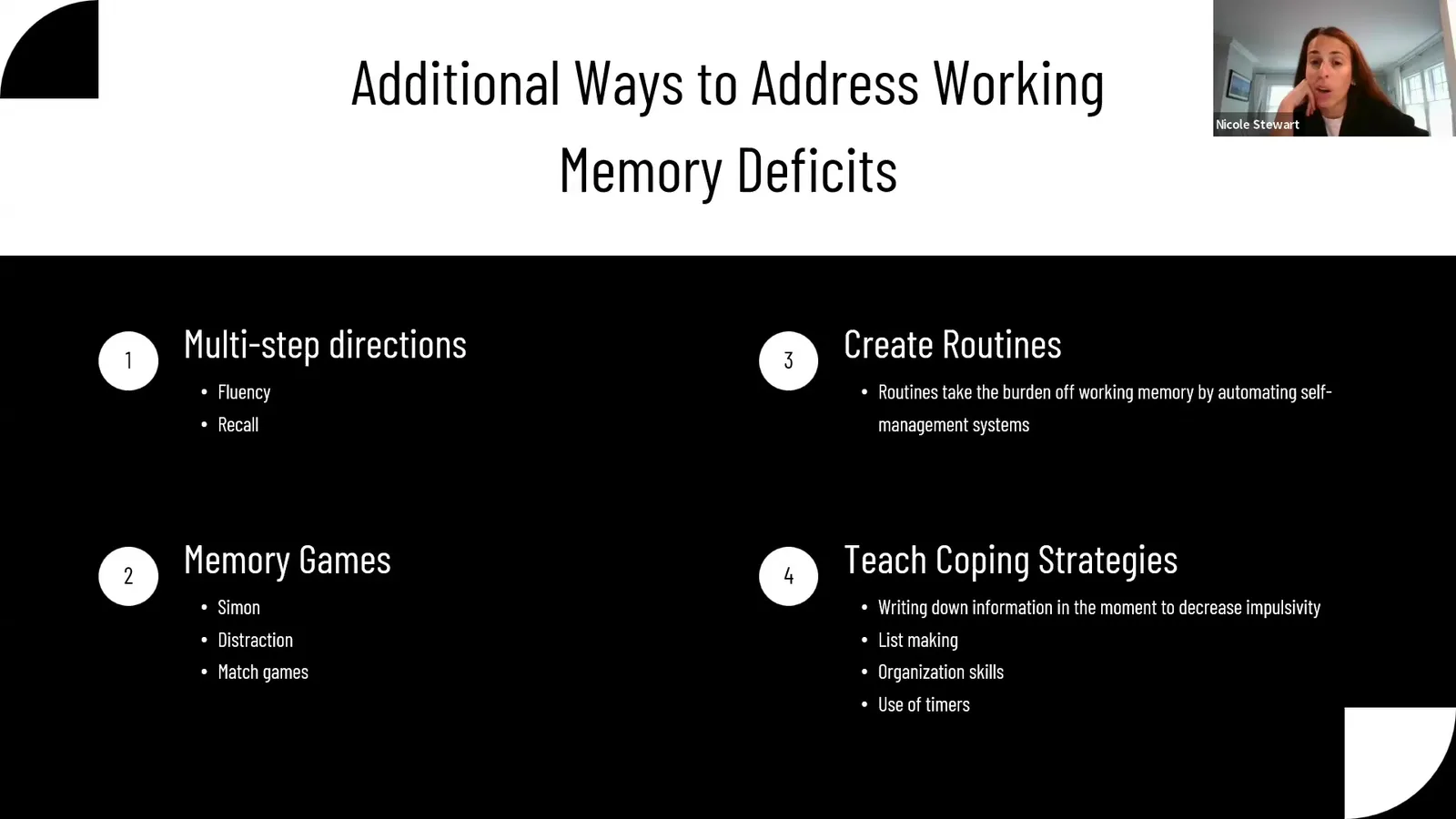
So train that capacity on purpose. Memory games help. One card game has you learn a number string, answer an unrelated question, then recall the number. Simon works the same way. I use a silly sentence game: I say a sentence, we do something else, then the child repeats it. I also ask what four things we did today. Kids start making mental notes on purpose, because they know the question is coming and they get reinforced for it. Social emotional play with action figures lets kids rehearse real situations, one step between structured and natural. Social spy builds this too, because the child has no lines to deliver. One less job to run is like training wheels on a bike.
Their working memory is how fast your brain processes and how accurate your brain processes to code and understand information.
From the talk — Nicole Stewart
Impulse control, and what the mindfulness research supports
Watching the room cuts both ways. A child sees peers whacking each other with toy swords and joins in. Then the impulse runs ahead of the rule and someone gets hit in the face. The social lesson landed. Impulse control did not. Blurting, interrupting, trouble waiting, and switching a game mid-play all live here. A five year old agrees to play pirates, then flies off as a butterfly. The friend goes and finds someone who will stay in the game.
Two recent studies trained these systems directly. Harper and colleagues in 2023 and Singh in 2022 used stepped computer programs. One was central executive training (practice on planning and self-control). The other was inhibitory control training (practice on braking an impulse). Both used repetition and massed trials (many repeated practice tries), which looks a lot like what we already do. Singh and colleagues found the programs beat behavioral parent training for academic outcomes. This held for kids 8 to 13 years old with ADHD. Harper and colleagues looked at set shifting, also called cognitive flexibility (switching from one thing to the next). Inhibitory control training improved it the most, and flexibility ties back to social skill. The programs are not available to practitioners yet. I went looking. The real question is what we can borrow from them. We can use stepped levels, heavy repetition, and practice in real settings instead of on a screen.
Mindfulness is the other lever. One study offered mindfulness training to 10 adolescents with ADHD and their parents. It covered breathing methods and conflict resolution, and parents got a CD of exercises to use at home. Teens reported better outcomes across all measures: fewer behavior problems, better attention, and fewer social conflicts. Fathers in particular observed a greater reduction of issues. The study also found that teaching teens about their own ADHD symptoms helped them rather than harmed them.
Most kids shut down the second you say mindfulness. Aim low at first. The no talking game is my favorite. We both draw for five minutes with nobody speaking, then we share. One child passed me a note to ask if humming counted. That is purposeful communication instead of blurting. Parroting builds listening: the child repeats my words back every few words, which also primes a transition. Freeze dance or the floor is lava pairs two deep breaths with each freeze. The body is already revved up, so the child practices coming back down while having fun. Later you run the same breathing with a trigger in place. Model it, do it together, and adjust it per child and per parent.
I don't want to say trick them into mindfulness, but you have to start slowly aim for toleration
From the talk — Nicole Stewart
Emotional regulation and self-acceptance as the end goal
Emotional regulation (managing feelings and reactions) sits right next to impulse control. Getting dysregulated (losing control of a reaction) means impulses misfire. That shows up as big overreactions, actions the child regrets, and trouble knowing when to engage or walk away. It also pushes peers away. A kid who melts down over losing stops getting invited to play games at all.
The order of teaching matters here. Start much lower than breathing. First, get the child to tolerate talking about emotions. Then label your own out loud: I am frustrated because I burned dinner. Then teach them to spot the whole range, not just mad and sad. Embarrassed. Lonely. Jealous. The mixed ones that take a few words to name. We manage each feeling differently, so each one needs its own name.
The last target is self-acceptance. Kids with ADHD get rejected and criticized more, so shame builds fast. They are also more likely to be bullied, ostracized, abused, or taken advantage of. When we hide those experiences, kids start to believe they earned them. When we name it, we tame it.
Self-acceptance is a behavior, so we can break it down and teach it. The parts are concrete: knowing your own limits, noticing what is hard, and asking questions. It also means asking for help and seeking feedback from a trusted friend. That makes it a behavioral cusp, because a child who can do that keeps learning without us. Language does work here too. Yet. Figure it out. Handle it. Validate the feeling, but still hold the line. Tell them: I believe you feel awful, and I believe you can get through today. A kid who gets through a hard day learns they are stronger than they thought.
kids are not going to learn emotional regulation by telling them to take deep breaths when they're angry
From the talk — Nicole Stewart
Common questions
How do I tell if social skills are a skill deficit or a performance deficit?▾
Observe the child in real social settings and ask them directly what is hard about groups. Gather parent and teacher input too. Watch whether the child can describe and show the skill. If they still drop it in the moment, treat it as a performance problem. If steps are missing, like never getting a listener's attention before talking, you have a skill gap to teach.
Why can my client hold it together at school and fall apart at home?▾
Many kids mask at school instead of managing. Holding everything in all day burns real physical and mental energy, so there is nothing left later. Tired and hungry kids have more behavior problems. Masking is not the same as learning to manage, which is why it keeps breaking in the next setting.
What is the social spy strategy?▾
You give the child a mission to collect information about people. They get a notebook and one specific thing to count or rate. They practice on you first, then in a low-stakes public place, then in real settings like aftercare. The second rule is to stay discreet. The goal is observational learning (learning by watching others). The child picks up social rules without being taught each one directly.
Does teaching a teen about their ADHD make things worse?▾
The mindfulness study covered in this talk found the opposite. Awareness of their own symptoms was helpful to adolescents, not harmful. Teens who learned about their diagnosis and worked on self-acceptance did better across measures. Hiding it is what builds shame.
Are the executive function computer programs from those studies available to use?▾
No. The speaker searched for them and they appear to still be in research. The useful move is to borrow the design: stepped levels, heavy repetition, and massed practice. Then run it in real situations during sessions and parent training.
About the speaker
Nicole Stewart is a behavior analyst and a certified special education teacher. She has been in the field for almost 20 years, across many populations and settings, and now works in private practice with a focus on kids who have ADHD or anxiety. In this session she walked BCBAs through skill deficits versus performance deficits in ADHD social skills, and what to teach for each.
This summary was generated from the recording’s transcript. Quotes are taken word for word from the talk.
What you'll learn
- 11. Learn research on social skills deficits. 2. Identify strategies to teach skill deficits in social skills repertoires. 3. Identify reasons for performance deficits, and strategies to address those reasons.
Related talks
Talks that cover the same concepts
The ADHD Exchange: Best Practices
ABA Made Ez
The ADHD Exchange: Teaching Emotional Regulation
ABA Made Ez
The ADHD Exchange: Classroom Management: ADHD Behavior Management
ABA Made Ez
The ADHD Exchange: Understanding the Neurobiology of ADHD
ABA Made Ez
The ADHD Exchange: Executive Functioning
ABA Made Ez
OpenCEU is supported by advertising from third-party sponsors. Sponsors are clearly labeled, have no influence over course content, instructors, or CEU decisions, and never appear on certificates. The BACB does not sponsor, approve, or endorse OpenCEU sponsors or their products.