The ADHD Exchange: Best Practices
Presented by Nicole Stewart
ADHD remains underrecognized, and there is a shortage of behavior analysts trained to support it well. This training for BCBAs opens with an overview of ADHD, from its history through current views on diagnosis and the domains it affects: emotional regulation, social skills, executive functioning, and self-management. Participants then review the treatment options available to caregivers, why ABA is not yet widely accepted as an ADHD treatment, and how families can monitor the safety, benefit, and progress of any intervention. The core of the training covers best practices for ABA with this population, including four service models (intensive, consultative, weekly therapy, and parent coaching) and the clinical do’s and don’ts that make sessions effective: pairing and teaching through reinforcement, building on client interests and intrinsic motivation, using token systems with caution, embedding choice, collaborating across settings, and keeping goals flexible and data-driven. The final section focuses on parent coaching, drawing on research on behavioral parent training and outlining a meaningful coaching approach built on clear goals, transparency, active listening, and follow-up on generalization. Behavior analysts leave with practical strategies for delivering ABA services to clients with ADHD and their families.
Sign in to buy — $17One-time purchase, permanent access. Cert delivered to your inbox the moment you pass the quiz.
About this CEU
ADHD remains underrecognized, and there is a shortage of behavior analysts trained to support it well. This training for BCBAs opens with an overview of ADHD, from its history through current views on diagnosis and the domains it affects: emotional regulation, social skills, executive functioning, and self-management. Participants then review the treatment options available to caregivers, why ABA is not yet widely accepted as an ADHD treatment, and how families can monitor the safety, benefit, and progress of any intervention. The core of the training covers best practices for ABA with this population, including four service models (intensive, consultative, weekly therapy, and parent coaching) and the clinical do’s and don’ts that make sessions effective: pairing and teaching through reinforcement, building on client interests and intrinsic motivation, using token systems with caution, embedding choice, collaborating across settings, and keeping goals flexible and data-driven. The final section focuses on parent coaching, drawing on research on behavioral parent training and outlining a meaningful coaching approach built on clear goals, transparency, active listening, and follow-up on generalization. Behavior analysts leave with practical strategies for delivering ABA services to clients with ADHD and their families.
Credits
1.5 CEUs · 77 min
From the talk
What was covered
How BCBAs (board certified behavior analysts) can serve clients with ADHD: four service models, reinforcement without token traps, and parent coaching that carries over at home.
- Match the service model to the case. Intensive ABA (applied behavior analysis, teaching skills through learning science) needs funding that ADHD alone rarely brings. Weekly skill sessions or parent coaching often fit better instead.
- Build sessions around the client's real interests, because an ADHD brain works on interest, not on being told to comply.
- Use token systems (point and prize charts) only for narrow jobs. Good examples are a disrupted routine or one specific habit, not your whole plan.
- Target skill building instead of behavior reduction. Write progress to include tolerance, flexibility, and calmer family routines.
- Treat shutdowns and precursor behavior (early warning signs) as teaching moments. Cut corrections hard, since kids with ADHD already hear far more of them.
- Close every parent coaching cycle by checking whether the skill shows up at home without you in the room.
Why So Few Behavior Analysts Serve ADHD Well
ADHD is everywhere in our caseloads. Training on it is not. Nicole Stewart opened this talk by naming that gap. There is very little training for behavior analysts in this space. She taught herself much of it, with supervised experience along the way. She has worked in public schools, private schools, clinics, and homes.
Money is part of the problem. ABA is usually not mandated for insurance coverage under an ADHD diagnosis. Autism has that mandate. ADHD and anxiety often do not. So families look elsewhere, and providers never build the skill set.
Research is the other part. Most ADHD studies look at medication. Studies on ABA with ADHD are thinner still. No research means no funding. No funding means no training. Our field does not like to act without evidence, but somebody has to go first. Stewart's plan is to train enough providers that families start asking for the service, which builds pressure for coverage.
Recognition is weak too. She described a parent whose school told them not to seek a diagnosis, because the child behaved in class. A diagnosis does look at symptoms across settings. But many kids mask (hide symptoms to fit in), and we cannot see what it costs them. Good behavior in one room is not proof that nothing is wrong.
So most of the research that's done on ADHD is about medication.
From the talk — Nicole Stewart
A Fast History of ADHD and the Domains It Touches
Attention problems are not a modern invention. They were described as far back as the 1700s, as a lack of steady attention to one thing. In the 1950s, ADD was added to the DSM (the manual used to diagnose mental illness), with or without hyperactivity. Ritalin was approved around then, and stimulants (medicines that increase alertness and activity) were overused for years. If a kid was hyper, he got a pill. There was not much else.
ADHD entered the DSM in the 1980s. The American Academy of Pediatrics did not issue guidance until 2000. Strattera arrived in 2002 as the first option that was not a stimulant. The DSM-5 now lists three presentations: inattentive, hyperactive or impulsive, and combined. It also adds mild, moderate, and severe levels.
The talk named four affected domains: emotional regulation, social skills, behavior management, and executive functioning (planning, starting, and organizing tasks). Executive functioning covers a lot. It stretches from getting dressed without drifting off task to planning a month long project or packing for a game. It also pulls in self-management and some emotional regulation skills.
Two clinical points stood out. First, impulsivity is not ignorance. Second, shame spiraling (a small mistake snowballing into self blame) is common. A tiny mistake can snowball into feeling like you have no friends, in seconds. Stewart separates a tantrum from a meltdown. In a meltdown, the brain is offline. She uses a five point scale and names the number out loud, so a child can catch the slide early. Precursor behavior (small signs before a blowup) is your cue to step in and teach.
They usually do know better, but their brain is their impulse is moving faster than their cognitive rational brain.
From the talk — Nicole Stewart
Helping Caregivers Judge Treatment Options
Parents who Google ADHD and behavior therapy find a short list. Stewart pointed to a table of recommended techniques. It listed positive reinforcement (rewarding good behavior), timeout, response cost (losing a reward), and token economy (points traded for prizes). Those are our words. Three of the four lean on punishment. That is what families think behavior therapy is, which is why so many arrive saying a sticker chart failed them.
Other options show up too: occupational therapy, counseling, play therapy, speech, and medication. Medication can work well, and pediatric guidance recommends pairing it with behavioral therapy. A CDC list names psychologists, psychiatrists, social workers, marriage and family therapists, cognitive behavioral therapists, and ADHD centers. Occupational therapy is often missing, even though sensory work can help a child understand their own body.
Cognitive behavioral therapy (CBT, therapy that targets thoughts and actions) came up as a useful comparison. With young children, Stewart does CBT without the C. A five year old does not need to hear about catastrophizing (blowing a problem out of proportion). They need to know a meltdown happened and that the team will work on it.
Stewart gave caregivers four questions for any option. Could this cause harm, directly or indirectly, including lost time on something that would have worked? What is the expected benefit, and what does the evidence say? Do we actually fit each other, since poor rapport (a weak working relationship) weakens any treatment? And are we making progress inside and outside of sessions? Progress may look small: longer tolerance, more flexible thinking, or parents who stop adding fire to the fire.
I can't teach them if they can't focus on what I want to teach them.
From the talk — Nicole Stewart
Four ABA Service Models for Clients With ADHD
Intensive ABA runs 10 to 40 hours a week in a tiered model. Technicians deliver the sessions, and a BCBA supervises the work. Funding for ADHD alone is rare. It mostly appears when there is a comorbid diagnosis (a second diagnosis as well), such as autism with ADHD. Intensive service fits families with severe problem behavior, a need for consistency, or parents worn down by many daily battles. When it is out of reach, Stewart suggests a nanny or sitter who receives caregiver training. That puts someone with a behavioral mindset around the child more often.
The consultative model is the one most used for ADHD, often in schools. The work tends to be a functional behavior assessment (a study of why behavior happens) and a behavior plan. The focus is usually classroom disruption. It is often not very neurodiversity affirming (respectful of different brain types). School based analysts often struggle to balance the classroom's needs with the child's. Funding may come through the school or an independent educational evaluation (a school funded assessment by an outside evaluator).
Parent coaching means training caregivers directly and measuring what changes at home. Insurance rarely covers ADHD coaching, so there are fewer mandates and more room to shape support around the family.
Weekly therapy was the model Stewart spent the most time on. She calls it batting practice: 30 to 45 minute sessions, once or twice a week, one on one. The targets are emotional regulation, executive functioning, and social skills. The focus is skill acquisition (building new abilities), not behavior reduction. In a tiered setting, train one person well and give them a clear session format.
The more you practice, the better you're going to get at them.
From the talk — Nicole Stewart
Session Do's and Don'ts That Make the Hour Work
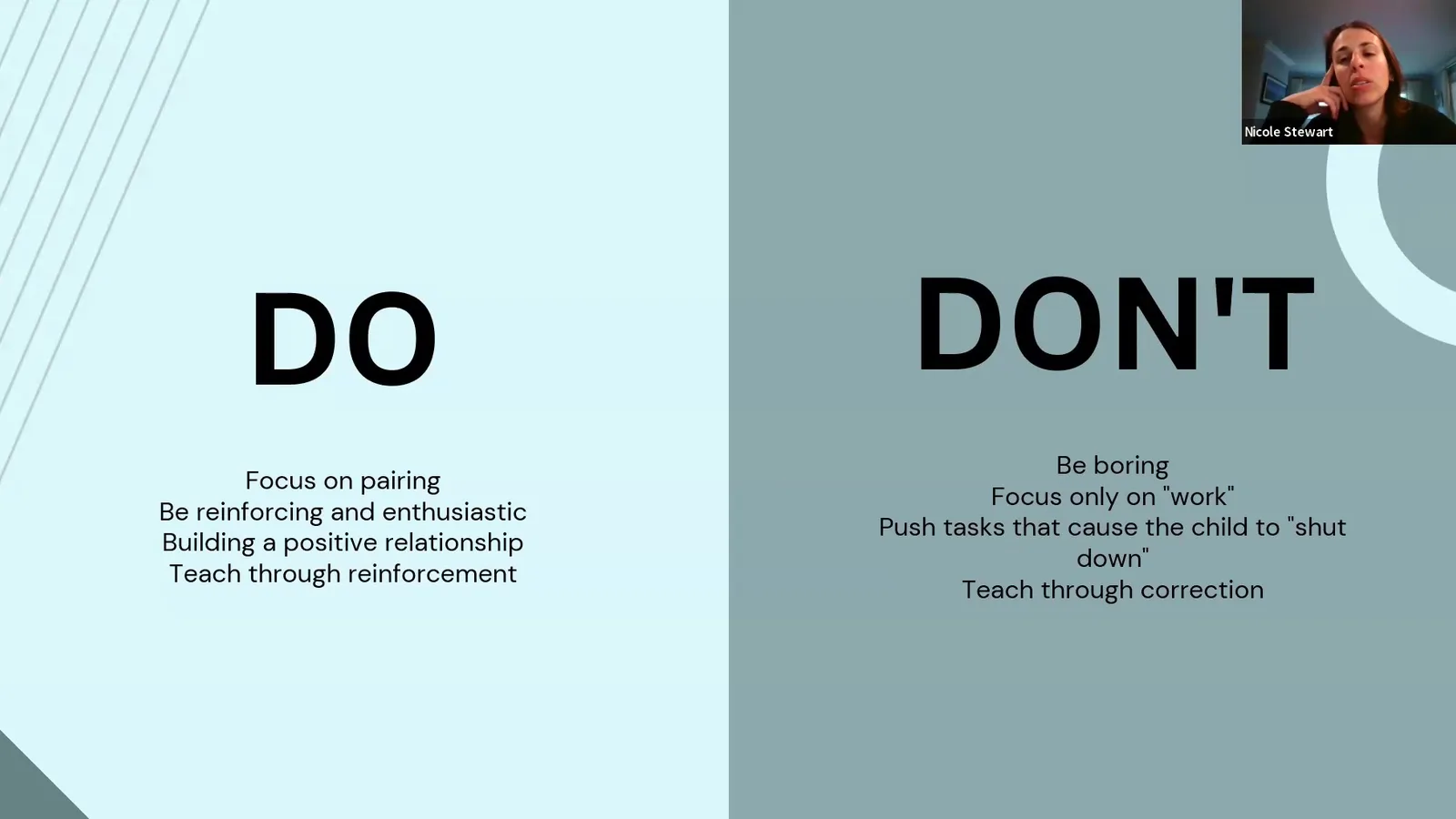
Start with pairing (building a fun link with you before making demands). Be enthusiastic. Teach through reinforcement (anything that makes behavior more likely), which does not mean edibles and prizes. It means being genuinely proud and rewarding effort. Stewart praises the effort, even on a hard day. She points out that a child went too far and melted down, but also fought it at first. Classic shaping (reinforcing small steps toward a goal) says not to reward earlier steps again. Stewart's view is that everyone's best looks different each day, so she finds something real to praise.
Do not be boring. An ADHD brain is hunting for dopamine (the brain's reward chemical). A session built only on trials and compliance will shut a kid down. One client refused anything that looked like work for a full year. After real relationship building, that client now walks in ready to list what was hard that week and ask what comes next. You earn the right to push harder later, not on day one.
Cut corrections. Avoid right and wrong framing when you can. If a child scribbles on your paper, try, "it looks like you needed to scribble right now," instead of a reprimand.
Lead with interests and intrinsic motivation (wanting to do something for its own reward). Stewart has taught emotions by having kids design an angry Pokemon card, then giving it a coping skill. Other kids draw, use pretend play, or record a scene and narrate it on replay. Embed choice: let a child circle three problems instead of ten, or dictate the answers while you write. Ask whether the problem is a skill gap or a motivation gap. Stay flexible when a session falls apart, but do not let the client run the whole time. If you play catch, make every catch answer a question.
children with ADHD receive four times as many corrections as a neurotypical child, which can really negatively impact their self-esteem
From the talk — Nicole Stewart
Token Systems: Narrow Uses, Real Risks
Stewart does not use many token systems (point and reward charts) with this population, even though public guidance recommends them. Her concern is dependency. The ADHD brain can latch onto the reward system itself. Then parents report that nothing gets done unless something is in it for the child, and chores off the chart stop happening.
She did name three uses that hold up. One is a disrupted routine, like travel, where predictability is gone. A simple tally for good moments keeps the adults pointing at what is going well. That is reinforcement of alternative behavior (rewarding a better behavior instead) in plain clothes. Two is one specific, narrow problem. She used ten rehearsed goodbyes with checkmarks. A fun activity at the end taught a child to separate from parents. Three is habit building, where effort is low but motivation is missing, like brushing teeth.
The common thread is that the system has a job and an end point. When Stewart gives a small end of session prize, she adds a skill to it. Before a child picks from the treasure bag, she asks them to name the four things they did that day. That builds working memory (holding information in mind to use it) while the reward is delivered.
Older clients often need none of it. Many already know their attention is a problem and are glad someone finally wants to help.
And so instead of creating this flexible thinking, you're actually creating more rigid patterns of thinking.
From the talk — Nicole Stewart
A Two Activity Intake That Tells You Almost Everything
Stewart opens new cases with the same two activities. The first comes from a book called A Little Spot of Emotions. Kids color and cut a set of color coded emotions. She watches for whether they can name emotions, name causes, read how she feels, and connect feelings to the body. If they cannot name emotions yet, the later questions wait.
The activity also surfaces other things. How long can a child stay with a task? How are their fine motor skills? One child colored everything well but had trouble the moment cutting started. That tells Stewart what materials to bring. If a child cannot write at an age appropriate level, worksheets are out. If a child dislikes mess, Stewart skips a volcano demo for anger too.
The second activity is a pre coding game (a logic and sequencing activity) based on Little Red Riding Hood. The child sets up a board from a picture, then moves the character home. Almost no client has seen it before, which is the point. Stewart watches how they learn something new: do they follow directions, watch a model, and copy a picture? One child would play only if he made up his own path, and he shut down when told how. That same pattern was already showing up in his classroom, so it became a goal.
The game also measures problem solving and frustration tolerance. Some five year olds finish the hardest level. Some ten year olds quit on the first. Both results tell Stewart where to start.
It allows me to assess so many different things and then also gives me a sense of what kind of activities to choose.
From the talk — Nicole Stewart
Parent Coaching That Reaches the Home
Research on behavioral parent training shows gains in positive parenting and parent competence (confidence and skill as a parent). It also shows drops in oppositional behavior (push-back and defiance) and in negative parent behavior. Results on whether it eases ADHD symptoms are mixed. Stewart is fine with that, because symptom removal is not the goal. The brain is the brain. The goal is a household that understands it and runs more smoothly.
Parenting is trial and error, and the errors cost more here. Some kids have rejection dysphoria (deep pain from criticism), so a sharp word can cause a full meltdown. Parents then cycle fast through failed attempts and feel awful. A coach breaks that loop by explaining what a failed attempt taught them about a missing skill.
Stewart's coaching rests on four pieces. Transparency means sharing her goals and what happens in session, without reporting every private thing a child says. She keeps the child's space safe, and passes along the theme instead. Shared language matters too. One client was making red choices in class. Teachers and parents began using red and green choices as well. The child started naming green options, like asking for a walk. Active listening means tracking what keeps coming up at home, even when a parent says things are better overall.
Follow up is the fourth piece, and it drives the plan. If a parent says a child still cannot play alone, Stewart builds five minutes of playing alone into sessions. She then hands that skill to the family to try at home. A skill that only works with Stewart in the room is not worth much. She also keeps her praise loud enough for the child to overhear, because these kids rarely hear good things about themselves.
We're looking for everybody to create a management system that understands and accepts that this is how this child's brain works.
From the talk — Nicole Stewart
Common questions
Why isn't ABA widely accepted as an ADHD treatment?▾
Most ADHD research studies medication, and very little looks at ABA with this population. That thin research base leads to little funding and almost no provider training. Our field also avoids acting without evidence, which keeps the loop closed. Stewart's answer is to train more providers so demand grows and coverage follows.
Will insurance cover ABA for a child with only an ADHD diagnosis?▾
Usually not. ABA is generally not mandated for coverage under ADHD or anxiety the way it is for autism. Funding is more likely when there is a second diagnosis. It can also come through a school or an independent educational evaluation in consultative work.
Should I use a token economy with a client who has ADHD?▾
Use it sparingly and for a narrow job. Good uses include a disrupted routine, one specific target like practicing separations, or building a low effort habit. Heavy use can create dependence on the system, so the child stops doing anything that is not on the chart. That builds rigid thinking instead of flexible thinking.
What should I target if not problem behavior?▾
Stewart targets skill acquisition: emotional regulation, executive functioning, and social skills. The question is what skill is missing that would let this child handle the situation better. Replacements matter more than reductions.
What does progress look like when goals move slowly?▾
It often looks like tolerance and flexibility before it looks like mastery. A child sitting through one activity you chose, then trading turns choosing, is real progress. So is a family that stops escalating during sibling conflicts. Track those changes, not just skill counts.
How do I handle a client who shuts down on hard tasks?▾
Treat the shutdown as the teaching moment and name what you see in their body. Check whether it is a skill problem or a motivation problem. Then modify the demand: do it together, model it first, or cut ten items down to three. If precursors reliably lead to unsafe behavior, teach the replacement at the precursor, not after.
About the speaker
Nicole Stewart is a BCBA who runs her own private practice supporting learners with ADHD or emotional disturbance. She is also a special education teacher. She has worked in public schools, private schools, clinics, and homes. She serves on the board of the Association for Science in Autism Treatment. She parents a child with ADHD, and she credits that experience with shaping how she coaches families and builds collaborative plans.
This summary was generated from the recording’s transcript. Quotes are taken word for word from the talk.
What you'll learn
- 11. Select an ABA service model that fits a client’s ADHD presentation, setting, and funding. 2. Design a reinforcement plan that builds on client interests and limits reliance on token systems. 3. Develop a parent coaching plan with transparent goals and checks for generalization at home.
Related talks
Talks that cover the same concepts
The ADHD Exchange: Teaching Emotional Regulation
ABA Made Ez
The ADHD Exchange: Classroom Management: ADHD Behavior Management
ABA Made Ez
The ADHD Exchange: Social Skills: Performance or Skill Deficit?
ABA Made Ez
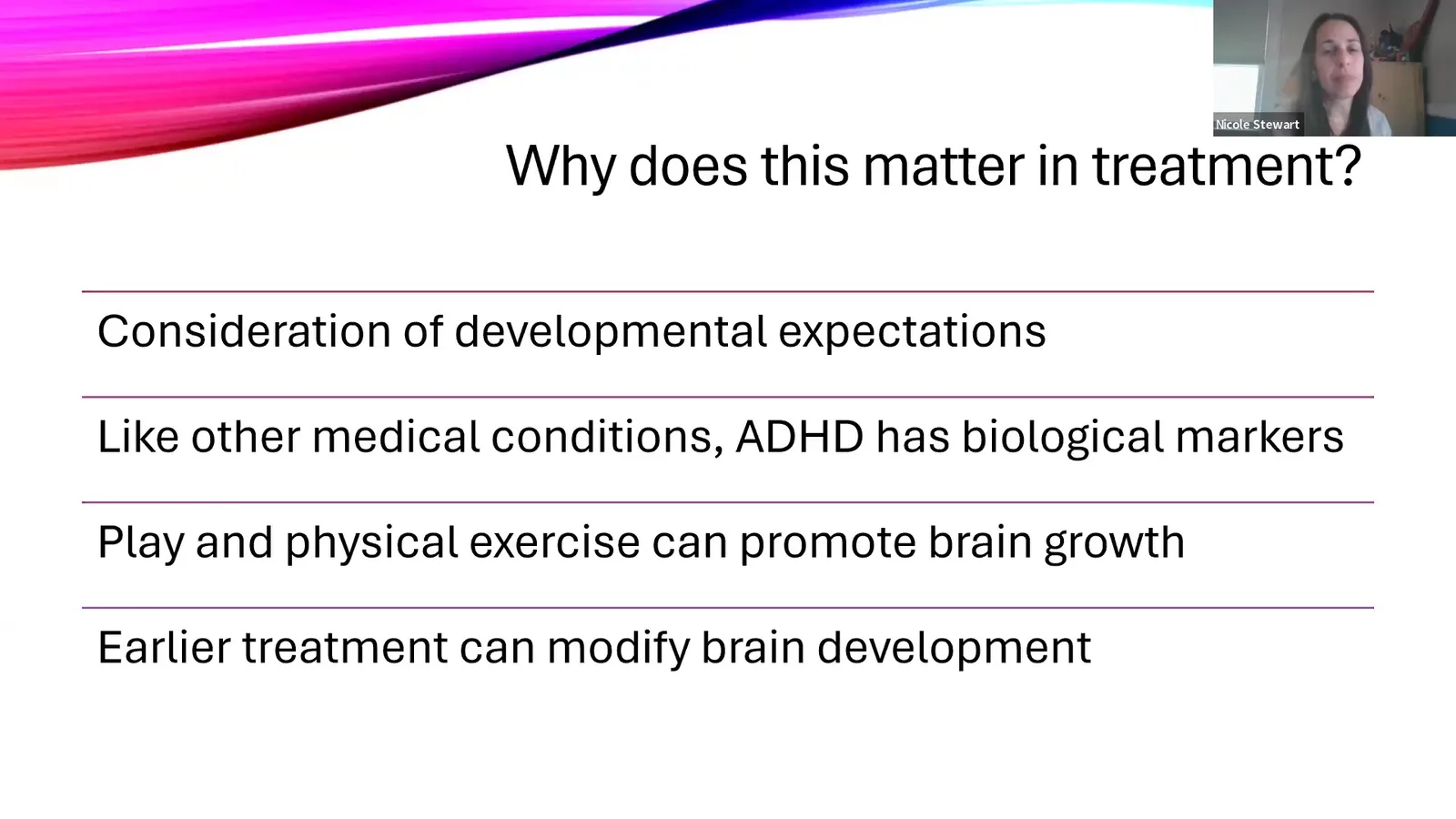
The ADHD Exchange: Understanding the Neurobiology of ADHD
ABA Made Ez
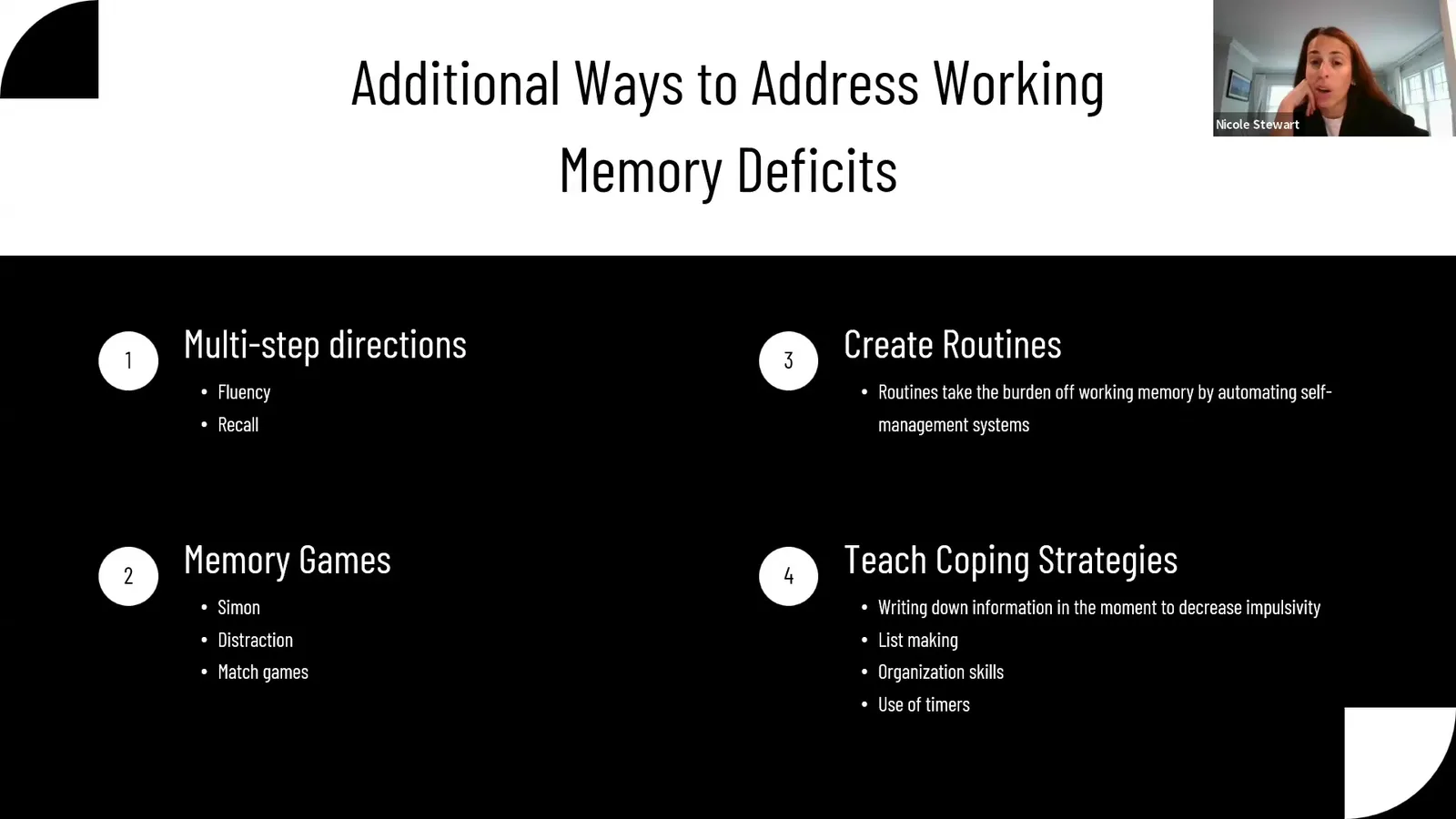
The ADHD Exchange: Executive Functioning
ABA Made Ez
OpenCEU is supported by advertising from third-party sponsors. Sponsors are clearly labeled, have no influence over course content, instructors, or CEU decisions, and never appear on certificates. The BACB does not sponsor, approve, or endorse OpenCEU sponsors or their products.