Values-Based Goal Setting in ABA Without Leaving Scope
Write values-driven goals that pass BACB scrutiny and still move behavior. Real examples from a BCBA-led CEU.
Key takeaway
To write a values-based goal in applied behavior analysis (ABA), name the value in the family's words, turn it into one observable behavior with a count and a schedule, and map that target to Behavior Analyst Certification Board (BACB) task list items F3, G1, and G2 in your plan so a reviewer can trace it.
ACT in ABA: Quixotic or Pragmatic?
On this page · 8 sections▾
To write a values-based goal in applied behavior analysis (ABA), name the value in the family's words, turn it into one observable behavior with a count and a schedule, and map that target to Behavior Analyst Certification Board (BACB) task list items F3, G1, and G2 in your plan so a reviewer can trace it. You are not writing an "Acceptance and Commitment Training (ACT) goal." There is no such thing. You are writing an ABA goal that uses ACT as one of your teaching strategies, and you defend it with the same BACB language you already use.
Why "increase acceptance" is not a legal ABA goal#
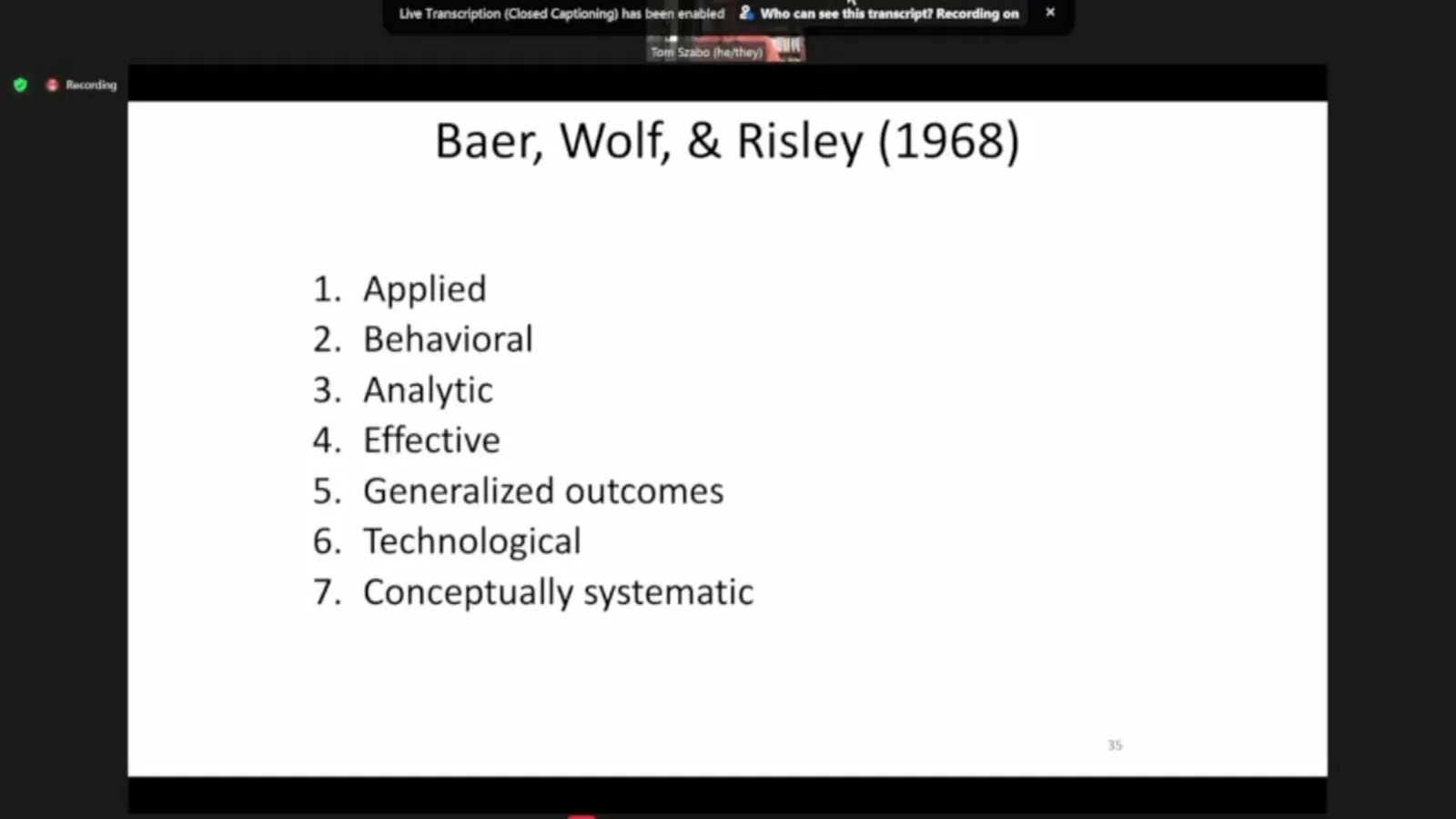
"Acceptance" is a private event. You cannot see it. You cannot count it. You cannot graph it. A reviewer cannot tell when it started or when it stopped. That fails the Baer, Wolf, and Risley test for what counts as applied behavior analysis, and it fails the BACB definition of a dependent variable.
So what is the right move? Keep the value in the conversation with the family. Keep it out of the goal line. The goal line gets a target you can see and count. The value lives in the rationale section of the plan and in the contingency contract.
There are no ACT goals. ACT goals don't exist. There are ABA goals, which are dependent variables that are observable and measurable socially significant behaviors. ACT is simply a strategy. It's a lure inside of your box of lures. You choose it when you need to use it, not when you don't. From the talk — Dr. Tom Szabo
That distinction protects you. If a payer or supervisor flips to your goal sheet and reads "increase acceptance of demands," they have a fair complaint. If they read "the learner will play a turn-taking game with his brother for thirty minutes on three days each week," they have a clean target. The ACT piece sits in your teaching plan, not your goal.
Translating values into observable, measurable behavior#
Skinner did not run away from the word "value." He used it. Values are the things we work for. What we value is what makes positive reinforcement land.
What does Skinner say about values? Skinner wrote several chapters in several books about values. For Skinner, values are those things that we work for. What we value is what contacts positive reinforcement. There's nothing terribly far away from a Skinnerian worldview when we talk about what's important. From the talk — Dr. Tom Szabo
That gives you a clean translation rule. A value is a class of reinforcers the person says they want more of. "Family" is not a behavior. "Family" is a class. Inside that class are dozens of small behaviors: eating dinner together, sharing a video game, calling Grandma. Those small behaviors are what you put on the goal line.
Here is the move, step by step:
- Ask what matters most. Use the family's own words. Write them down without cleaning them up.
- Ask what one small thing would count as living that value this week.
- Turn that small thing into a verb with a count, a setting, and a schedule.
- Check the verb against the seven dimensions. It has to be observable. It has to be measurable. It has to be socially significant.
- Write the value in the rationale. Write the verb in the goal line.
That is it. No new vocabulary. No private events on the data sheet.
A sample goal: from "family matters" to "30 minutes, 3 days a week"#
Szabo walked through this with a real kid. The kid is mad at his little brother. The brother breaks things. The parents let it slide. The kid says he is done.
What do I care about most? And here one person said my family. And what I'm willing to aim for that fits with the things I care about. Well, for this little guy, he's playing with my little brother. I'm playing video games with my brother for half an hour after we both get our homework done. From the talk — Dr. Tom Szabo
Look at what that sentence already gives you. A target behavior: playing video games with brother. A duration: thirty minutes. A frequency: three days per week. A setup condition: after both have finished homework. A value tag for the rationale section: family.
The goal line on the plan looks like this:
The learner will engage in cooperative video game play with his younger brother for thirty consecutive minutes, on three days per week, following completion of homework by both children, for four consecutive weeks.
Notice what is not in there. "Acceptance" is not in there. "Tolerance" is not in there. "Psychological flexibility" is not in there. Those words belong in your training notes. They do not belong on a goal sheet that a reviewer reads cold.
The ACT teaching pieces, like "see yourself as a ninja" or "I can feel angry without acting on it," are listed under intervention procedures, not under the goal. They are how you get the kid to the target. They are not the target itself.
Mapping the goal to BACB task list items (F3, G1, G2, G19, G22)#
This is where you protect the plan. For every ACT piece you add, point at a task list item. Szabo went through this on stage. Borrow his mapping.
BACB content area F3, identify and prioritize socially significant behavior change goals. Does ACT do that? Yeah. That's committed action. How about G1? Use positive and negative reinforcement procedures to strengthen behavior. That's contingency management we do inside of committed action. How about G2? Use interventions based on motivating operations and discriminative stimuli. From the talk — Dr. Tom Szabo
Translate that to your plan section by section.
F3, identify and prioritize socially significant behavior change goals. The value interview is your prioritization tool. The family said "family." You picked the brother behavior because the family ranked it above other targets. Note that in the rationale.
G1, use positive and negative reinforcement procedures to strengthen behavior. The reinforcer for the thirty-minute play is the Star Wars movie on the weekend. The reinforcer for the parent's piece is the brother is occupied so the parent can fold laundry. List both.
G2, use interventions based on motivating operations and discriminative stimuli. Teaching the kid to say "I am a ninja right now" before he walks into his brother's room is a self-instructed rule. That rule changes the value of escape. It is a motivating operation move. Document it as one.
G19, use contingency contracts. The matrix sheet the family filled out is a contingency contract. Attach it. Reference it by name.
G22, use procedures that promote maintenance. Build a fade plan. Move from three days a week to four. Move from thirty minutes to forty-five. Move the reinforcer from a weekly movie to natural sibling enjoyment. Write the fade schedule into the plan, not just the start point.
When a reviewer asks "what is the evidence base for this ACT step," you point at the task list item, not at a separate ACT literature. You are not doing therapy. You are doing ABA with one extra teaching tool.
What to write in the prior authorization#
Keep the prior auth boring. Boring goes through.
- Target behavior. One sentence. Verb, count, setting, schedule. Same wording you would use for a discrete trial program.
- Operational definition. What counts as the behavior. What does not count. A new staff member should be able to score it on the first try.
- Baseline. Current rate, frequency, or duration. Two weeks of data minimum.
- Mastery criterion. A number. A streak. A generalization probe.
- Procedure summary. Antecedent strategies, prompts, reinforcement schedule, fade plan. If you are using a values matrix or a contingency contract, name the tool and attach the form. Do not use the words "acceptance," "defusion," or "values clarification" without immediately following them with the BACB task list code they map to.
- Generalization and maintenance. This is G22. Write the second setting, the second person, and the schedule fade. Reviewers look for this and most plans skip it.
If you mention ACT at all in the prior auth, mention it as a teaching strategy in the procedure section. Never in the goal line. Never in the dependent variable.
Common goal-writing errors that get plans flagged#
A reviewer is reading fifty plans today. Yours has thirty seconds. These are the patterns that get flagged.
- Private events on the goal line. "Will increase emotional regulation." "Will tolerate frustration." Replace with the observable behavior that produces the change.
- No count or schedule. "Will play with brother." Add the number and the days.
- Reinforcer not specified. A G1 plan with no listed reinforcer is incomplete. Even "parent praise" is better than nothing.
- No baseline data. A target without a baseline cannot be measured for progress.
- No fade plan. A target without G22 documentation looks like a permanent program. Add the criteria for moving to the next step.
- ACT jargon in the goal. "Defuse from rigid thoughts about brother." Pull this language out of the goal and put the observable behavior in its place.
- No tie back to the family's words. A reviewer cannot tell why this target was chosen over the other thirty things on the assessment. Quote the family. One sentence in the rationale is enough.
Frequently asked questions#
Can a value be the same thing as a reinforcer? Often, yes. Szabo grounded values in Skinner's reinforcement language for exactly this reason. "Family" predicts that family-related events will reinforce. You still have to test it. Run a brief preference assessment. If the predicted reinforcer does not strengthen the behavior, your hypothesis was wrong and the value needs more specification.
What do I do when a caregiver's values conflict with the learner's? Write two contracts. The caregiver gets a target that fits their value. The learner gets one that fits theirs. Then look for a behavior that earns reinforcement for both. The brother play example does this. The kid gets his Star Wars movie. The parent gets thirty minutes of quiet. Same target. Two reinforcers. Document both under G1.
How do I document progress on a value if values are private? You do not document the value. You document the public behavior you and the family picked as a stand-in. Graph the play minutes, not "family connection." If the family says the value has shifted, run a new interview and pick a new target behavior. The graph follows the behavior. The narrative tracks the value.
Watch the full talk#
Szabo walks through this end to end in the recording, including the matrix sheet, the broccoli-burger framing, and the decision tree for when ACT is the right tool. The goal-writing piece runs about fifteen minutes in the middle of the session, and the BACB mapping is on his slide near the end.