What Is ACT in ABA? A Plain-Language BCBA Guide
ACT in ABA explained simply: the six processes, what makes it behavior analytic, and when to use it. Notes from a BCBA-led CEU.
Key takeaway
ACT in ABA is Acceptance and Commitment Therapy (also called Acceptance and Commitment Training) used as a strategy inside applied behavior analysis. It is built around six processes shown on a six-sided diagram called the hexaflex.
ACT in ABA: Quixotic or Pragmatic?
On this page · 8 sections▾
What Is ACT in ABA? A Plain-Language BCBA Guide
ACT in ABA is Acceptance and Commitment Therapy (also called Acceptance and Commitment Training) used as a strategy inside applied behavior analysis. It is built around six processes shown on a six-sided diagram called the hexaflex. BCBAs (Board Certified Behavior Analysts) use it to address private events like thoughts and feelings inside an ABA plan. ACT does not replace your contingency management. It supports it when direct teaching stalls and the client can use language to follow rules and make comparisons.
ACT is not a different therapy. It is a strategy inside ABA.#
ACT was first called comprehensive distancing. That name was clunky, so the field shortened it to ACT. The point of ACT is action. It helps a client move toward what matters, even when hard thoughts and feelings show up.
Dr. Tom Szabo frames it this way in the talk.
ACT is constructed specifically to bring us back to our behavior analytic roots. It is about action. Ultimately, ACT is about effective action in the world. In other words, it is truly applied behavior analytic. From the talk — Dr. Tom Szabo
That framing matters. ACT is not a side trip into therapy. It is one tool in your ABA toolbox. You pick it when the function of the behavior calls for it. You skip it when direct teaching is already working.
The six processes: acceptance, defusion, flexible self, present moment, values, committed action#
ACT has six processes. Each one is a repertoire of behavior. Each one can be taught and measured.
Acceptance is making contact with feelings instead of running from them. Defusion is stepping back from thoughts so they do not run the show. Flexible self is seeing yourself in many roles, not stuck in one label. Present moment is noticing what is here right now. Values are the things you work for over time. Committed action is the small step you take today toward those values.
Szabo names the model and the split between the flexible and inflexible sides.
hexagon format. We call this the ACT-EXA-FLEX. And as you can see, each point along the hexagon can be looked at both in terms of flexible and inflexible processes. You might say that, for example, acceptance is being willing to have contact with all of life's emotions. The flip of that is experiential avoidance. From the talk — Dr. Tom Szabo
In ABA terms, each process is a class of behavior under the control of motivating operations, antecedents, and reinforcers. You can write goals for the public behavior. You do not write a goal called "acceptance." You write a goal for what acceptance looks like in this client's life.
Each process has a flexible side and an inflexible side#
This is the part that makes ACT click for new BCBAs. Every process on the hexaflex has two sides. The flexible side helps the client move. The inflexible side keeps them stuck.
Acceptance is the flexible side. Experiential avoidance is the inflexible side. Defusion is flexible. Fusion is inflexible. Each pair plays out in the same way. One side opens up new behavior. The other side closes it off.
Take defusion as an example. Fusion is when a thought feels like a fact. The client cannot pull the thought apart from the action. Defusion is the skill of stepping back. The client sees the thought as a thought, not as a command. Then they can choose what to do next.
Your job in ACT is to nudge the client from the inflexible side to the flexible side. You do that with the same tools you already use. You teach. You shape. You reinforce. You track.
Why ACT stays in ABA scope of practice#
This is the question every BCBA asks. If ACT touches thoughts and feelings, is it still ABA? The answer is yes, when you do it as a behavior analyst.
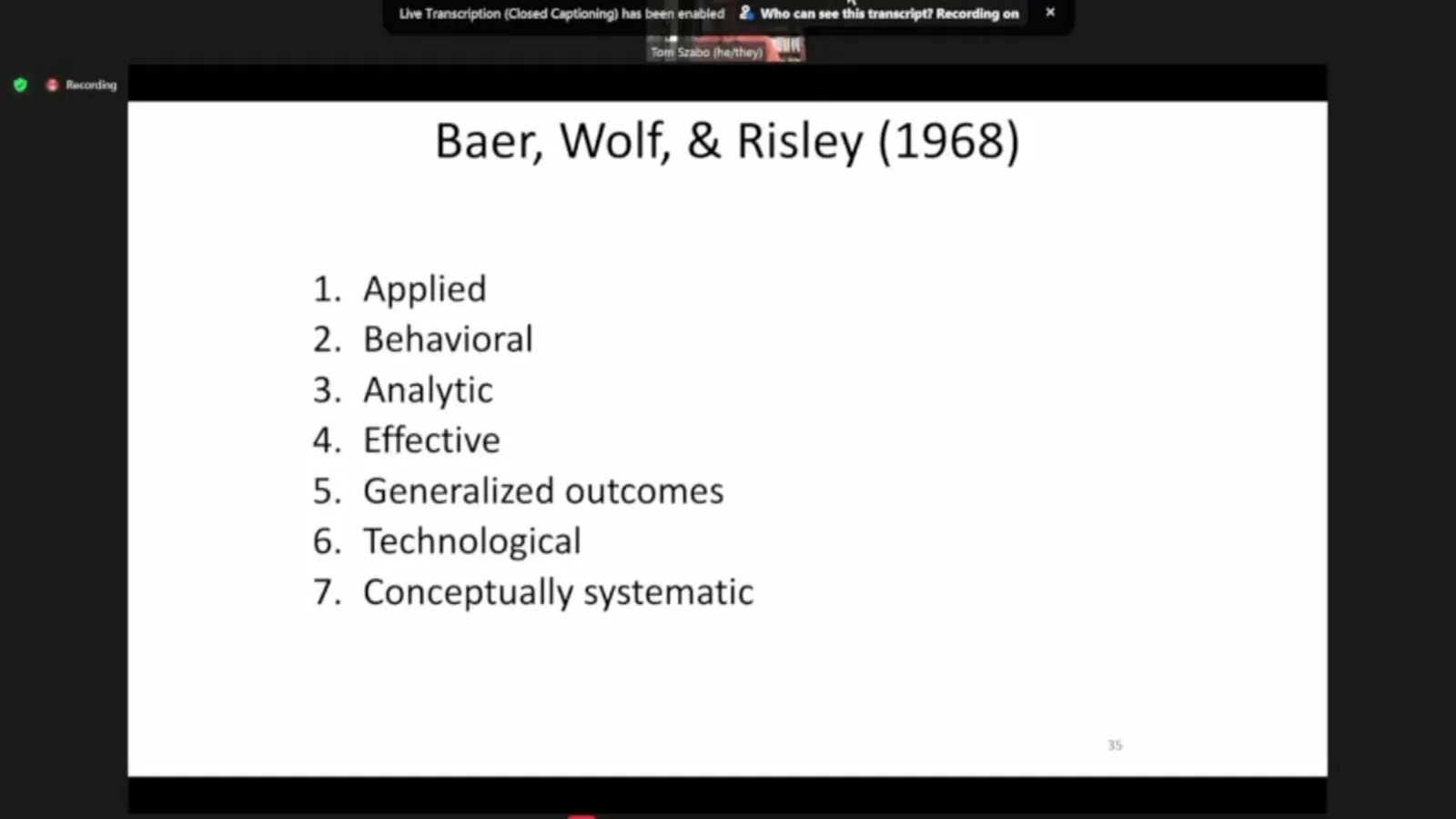
You use ACT in a training format, not a therapy format. You write ABA goals. You measure public behavior. You match every move to the seven dimensions of applied behavior analysis. You keep your work tied to the BACB task list.
use the psychological flexibility model or ABA as a clinical social worker or as a clinical nurse or as a clinical psychologist, but you can also use the same model slightly differently in a training format as an applied behavior analyst or as a safety consultant or as a coach or as a community activist or any other number of disciplines. From the talk — Dr. Tom Szabo
A clinical psychologist might use ACT as therapy. You use it as training. The difference is real. You are still doing reinforcement, motivating operations, rule-governed behavior, and contingency contracts. The labels on the BACB task list still fit.
When ACT belongs in your plan and when it does not#
ACT is not the first move. Direct contingency management is the first move. You run your functional analysis. You teach the replacement behavior. You reinforce. You program for generalization and maintenance.
You pull in ACT when two things are true. First, the direct work has stalled. Second, the client can do basic relational framing. That means they can compare two things, follow simple rules, and talk about their own behavior. If a client cannot do that yet, ACT will not help. Go back to the basic contingency work.
ACT is simply a strategy. It's a lure inside of your box of lures. You choose it when you need to use it, not when you don't. Which word do you use? Do you use applied behavior analysis? Do you use functional communication training? Or do you use acceptance and commitment training? Well, that depends on your goal. From the talk — Dr. Tom Szabo
When you do bring in ACT, start with a short ACT assessment. The Matrix interview is one option. A brief ACT functional analysis is another. The goal is to find the covert barrier that is blocking the direct work. Then you build a plan that targets that barrier and feeds back into your contingency management.
What this looks like for a kid you actually see on Monday#
Szabo walked through one example in the talk that makes this real. A kid wants to play video games with his little brother for thirty minutes, three days a week, after homework. That is the committed action. The value behind it is family.
What gets in the way is private. The brother has to do things his way. The kid gets angry. He does not want to share his toys. That anger is a covert barrier.
So the plan teaches a few skills. The kid learns to see himself as a ninja who can walk away. He learns to say, "Yes, I feel angry. I do not have to act on it." He learns to notice the breeze and the coyotes outside instead of locking in on the anger. The reward is real and built into the contract. Dad takes him to the new movie. Mom hangs out with the brother when friends come over.
That is ACT inside ABA. It is a contingency contract with values and acceptance baked in. The behavior is observable. The reinforcement is clear. The goal is written like any other ABA goal. The ACT pieces are how you get there.
Frequently asked questions#
Do I need a separate license to use ACT with my clients?
No. You do not need a therapy license to use ACT as a BCBA. You do need to stay in the training format and inside the ABA scope of practice. That means ABA goals, public behavior, measurable repertoires, and ties to the BACB task list. If you start treating mental health diagnoses, you are out of scope. If you teach acceptance, defusion, and values-based action as part of an ABA plan, you are inside it.
Is ACT the same as cognitive behavioral therapy?
No. CBT teaches clients to change their thoughts to change their feelings. ACT does not try to change the thought. ACT teaches the client to step back from the thought and act on values anyway. The hexaflex is rooted in Relational Frame Theory, which extends Skinner's verbal behavior. That makes ACT a closer fit for ABA than CBT.
Can I bill insurance for ACT under a behavior analysis authorization?
You bill for ABA, not for ACT. There are no "ACT goals" on a prior authorization. There are ABA goals that are observable, measurable, and socially significant. You list the goal as the dependent variable. You list the strategies under your usual BACB task list categories like reinforcement, motivating operations, contingency contracts, and self-management. ACT is how you do the work. ABA is what you bill.
Where to go next#
ACT inside ABA is a real skill set. The fastest way to see it work is to watch a BCBA walk through real cases, real contracts, and real client language.
Watch Dr. Tom Szabo's full talk on openceu.com to see the decision tree, the contingency contract, and the broccoli-burger example in action. The CEU is one BACB unit and the recording is free to view.