How to Explain ABA to Parents Without Jargon (Four Moves)
Four moves for translating behaviorese into everyday language so parents actually understand the plan, from a BCBA-led CEU.
Key takeaway
There is a four-move translation framework hiding in Brian Middleton's verbal behavior talk, and once you see it you cannot unsee it. Simplify the words.
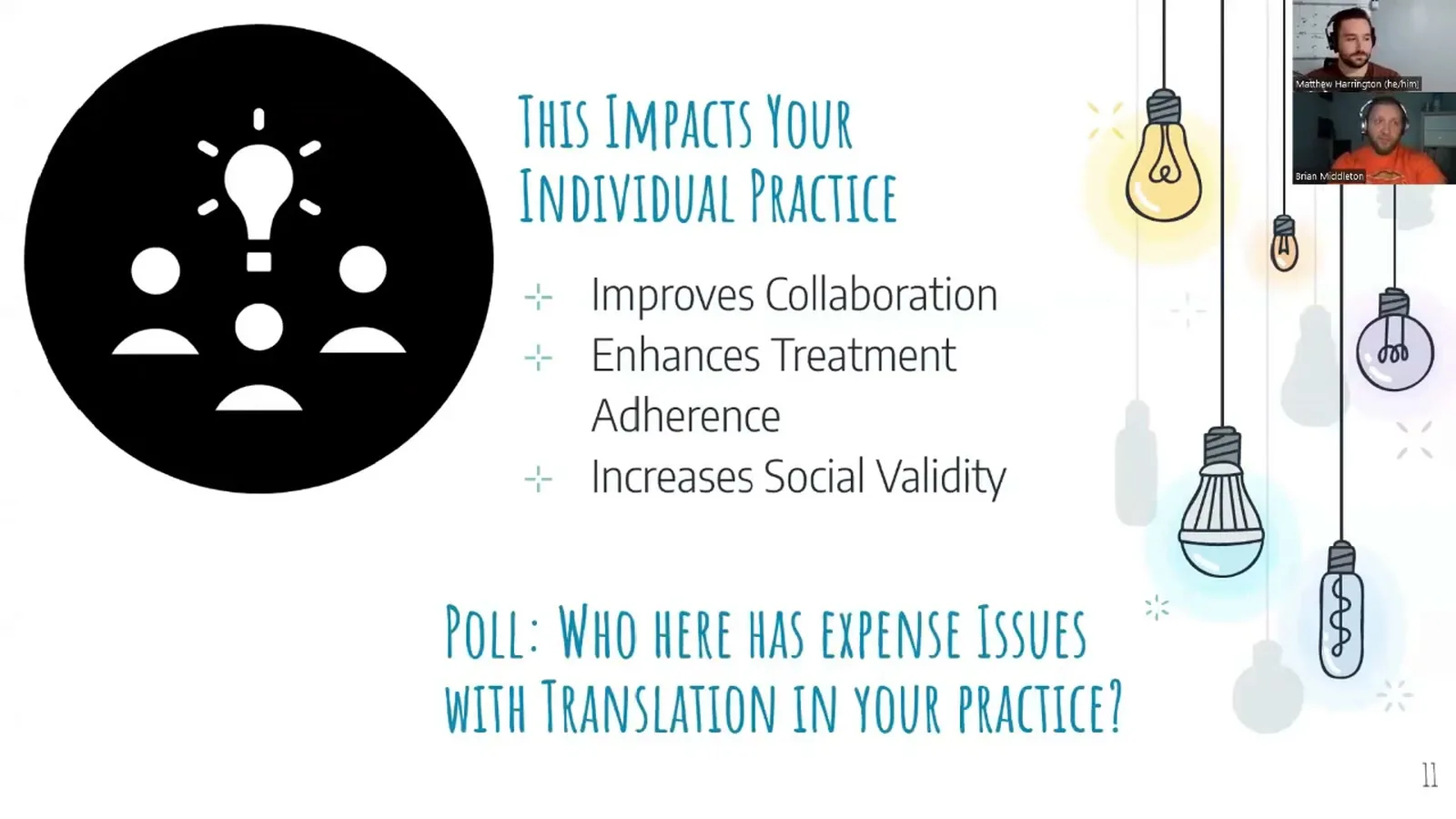
Verbal Behavior & Functional Language: A Practical Guide to Translating from & to Behaviorese
On this page · 8 sections▾
How to Explain ABA to Parents Without Jargon (Four Moves)
There is a four-move translation framework hiding in Brian Middleton's verbal behavior talk, and once you see it you cannot unsee it. Simplify the words. Lead with a real example. Use a visual that is not a graph. Take the parent's perspective the way Pat Friman did at the red light, when a stranger went from angry honking driver to a person who wanted to help because he finally saw the blue baby in the back seat. That same skill works in the classroom meme Middleton ends his talk with, where a teacher keeps scolding a student whose behavior is maintained by attention and the kid is happily soaking it up. The teacher is teaching the wrong lesson. Most of us are too, every time we hand a parent a treatment plan written in behaviorese.
This page packages those four moves into a workflow a board certified behavior analyst (BCBA) can run on Monday morning. Use it for parent coaching, for individualized education program (IEP) meetings, and for the awkward handoff to a new technician who has not yet built their applied behavior analysis (ABA) ear.
Why behavior analysts keep getting accused of running a cult#
Middleton names this one out loud. When people outside the field hear us speak, the precision sounds like code, and code sounds like a closed club. He has a sharp take on it. He says he studies cults for fun, and yes, a private vocabulary can be a cult marker. It can also be a science marker. The fix is not to throw out the precise words. The fix is to get fluent in moving back and forth between the precise words and the kitchen-table words.
The risk of staying in jargon is bigger than parents feeling dumb. When dissemination breaks down, the public fills in the gap with old ideas about ABA. Discrete trial at a table all day. Response blocking. Restraint. None of that is what most teams are doing now, but if we cannot describe what we are doing in plain language, the old image wins.
You can't make people see what you're seeing. You can't make people make the connections that you're making. That's why perspective taking is so critical and why behavior analysts need to do better at perspective taking. But at the same time, we need to create opportunities for that. From the talk — Brian Middleton
That quote is the boundary condition for everything below. Your job is not to force a parent to think like you. Your job is to lay out a path they can walk on their own.
Move 1: Swap one acronym at a time, not all of them#
The first move is the simplest. Replace one term per sentence, not the whole paragraph. If you say SD, FR2, MO, and EO in the same breath, the parent stops hearing you after the first one. If you say "we are using a special signal that tells your son a reward is coming," they stay with you.
Middleton calls himself NGWA, not good with acronyms, as a joke on us. He proposes a small study that should already exist. Take a behavior analysis paper. Show one group the standard version with acronyms and jargon up front and a single translation in parentheses. Show another group a version where the everyday phrase comes first and the technical term is in parentheses, fading the parentheses out as the paper goes. Test what each group remembers. He thinks the second group wins. Most BCBAs I know would bet the same way.
Here is the move on paper:
- Pick one technical term you are about to use.
- Say the everyday phrase first. Then drop the technical term in parentheses, the way Middleton suggests.
- Use the technical term again later in the same conversation, with no parenthetical, only if the parent reused it first.
If the parent does not pick it up, that is fine. You did not lose anything. You taught the concept. The label is optional.
Move 2: Bring the example before the definition#
This is the move most clinicians get backwards. We define motivating operations, then give an example. Middleton flips it. He opens with the seatbelt beep. The car bugs you until you click in, the beep stops, and now you click in faster the next time. That is positive punishment of not-buckling and negative reinforcement of buckling, working together. He says the definition out loud only after your brain has already done the work.
He does the same thing with the conditioned motivating operation (CMO-R), the kind that signals things are about to get better or worse. He uses the water ripple in Jurassic Park. The first time the cup vibrates, nothing happens. By the end of the movie, the ripple is a warning that the T. rex is coming, and a Brooklyn Nine-Nine cold open can use the same vibrating coffee cup as a joke because the audience has been conditioned. The example does the teaching. The definition just gives the parent a name for what they already understood.
Try it with reinforcement. Do not start with the textbook line. Start with the toddler who learned that whining at the cart in Target gets a fruit snack. The whining is going up because the snack followed it. Now the parent has the concept. Now you can name it.
So we try to simplify that's replacing complex jargon with everyday terms. Don't jargon at me, bro. Provide relatable examples and analogies, make it concrete and interesting. Visuals, visuals, visuals, visuals. There's more than charts and graphs, people. From the talk — Brian Middleton
Move 3: Use a picture, a meme, or a movie scene, not a graph#
Graphs are for your team. Pictures are for everyone else. Middleton makes the case that memes are a real teaching tool, not a shortcut. The biologist Richard Dawkins coined the word meme to describe an idea that copies itself the way a gene does. There is a whole science of how ideas spread, called memetics, and behavior analysts should be paying attention.
A meme works the same way a salient stimulus works in your token economy. It grabs the eye. It is funny enough to share. It carries one clean idea. Middleton shows a slide where a baby is a "permanent product" of someone's behavior, and the room laughs and remembers what a permanent product is.
You do not need to be a graphic designer. You need three things.
- A template the parent already recognizes. A movie scene, a sitcom still, a kid show character their child watches.
- One caption that names the behavior concept in everyday words.
- A reason to share it. A handout, a quick text after a session, a slide in a parent training night.
Two cautions Middleton names. First, some templates carry pain or politics. Skip them. The Will Smith slap is the example he gives. Second, the picture can be read more than one way, so the caption has to carry the meaning. Test it on a colleague before you send it to a parent.
Move 4: Take the parent's perspective like Pat Friman at the red light#
This is the move most of us skip, and it is the one Middleton spends the most time on. He plays a clip of Pat Friman's red-light story, and the room goes quiet. The setup is famous in the field for a reason. You are late. The light turns green. The car in front of you does not move. You honk. You knock on the window.
You knock on her window, she looks up at you and she has tears in her eyes. And you look into the back seat and you see there's a baby back there and it's turning blue. And in that instant, our anger, frustration, irritation would be gone. From the talk — Brian Middleton
That is the move. When you take the parent's circumstances into account, the behavior you were about to label as resistance or non-compliance reads differently. The parent who is short with you in a meeting is the driver. The blue baby is whatever they are carrying that day. A sleepless week. A school district that called twice. A diagnosis that is still fresh.
You do not need to know the whole story. You only need to act as if there is one. That is what Friman is showing. That is what Middleton wants more behavior analysts to do.
A practical version for your next meeting:
- Before you open your folder, ask one open question about the parent's week.
- Listen for the circumstance, not the complaint. What did they carry in with them.
- When you describe the plan, anchor at least one piece of it to the thing they said. The plan now sounds like a response to their life, not a download from yours.
How to test your script on a safe person before you use it on a family#
Middleton tells a story on himself. He recorded a quick video walking a baby past circling dogs and called it an S-delta. It was an SD. He never published it, but if he had, someone would have caught it. He uses the story to make a point. Practice the translation out loud, on a safe person, before you use it on a parent.
Kevin Hart does the same thing with a joke. He tries it in a small room, it lands flat, he tweaks it, he tries it again, until it works in a stadium. Your parent coaching script is no different. The first version is rarely the one that works.
Here is a small drill that takes ten minutes a week.
- Pick one term you used in a session. A mand. A CMO-R. Differential reinforcement of other behavior.
- Write one sentence that names the concept in everyday words, with no acronyms.
- Say it out loud to a coworker who is not a behavior analyst. A receptionist. A friend. A spouse.
- Ask them to repeat it back in their own words. Where they get stuck is the part to rewrite.
Do this for a few weeks and you will catch yourself using the parent-ready version in sessions without thinking about it. That is fluency.
A note on the meme Middleton closes with. A teacher scolds a student whose behavior is maintained by attention, and the kid is loving it. The teacher thinks she is delivering a punisher. She is delivering a reinforcer. That meme is the whole case for translation in one image. If the teacher had the everyday version of "function of behavior" in her head, she would have walked away from the desk instead of leaning in.
That is the job. Walk parents and teachers toward the version of behavior science they can actually use, one move at a time.
Frequently asked questions#
Should I drop technical terms from parent meetings entirely?
No. Drop them from the first pass. Use the everyday phrase first, then put the technical term in parentheses, then bring it back later only if the parent reuses it. The label is a bonus, not the goal. The goal is the parent leaving the meeting able to describe the plan to their partner that night.
What do I do when a parent shuts down the second I start explaining?
Start with everyday language and stay there. Middleton's rule is that you cannot force comprehension any more than you can force compliance. If a parent shuts down, you have used up your translation window for that meeting. Move to the next item, look for a different opening, and try again when the temperature is lower. Motivational interviewing techniques travel well into ABA for exactly this reason.
Is it okay to use memes in a clinical handout?
Yes, with two filters. First, pick a template that does not carry pain or politics. Second, write a caption that carries the meaning even if the picture is read a different way. Test the handout on a colleague who is not a behavior analyst. If they laugh and can tell you the concept, send it. If they have to ask what it means, rewrite the caption.
Keep building your translation reps#
The four-move framework is portable. Use it on the next IEP. Use it on the next new-staff training. Use it on yourself the next time you catch your own draft of a parent letter sounding like a journal article.
If you want to hear Middleton walk through every example in his own voice, with the full Pat Friman clip and every meme he pulled into the talk, watch the recording and earn the continuing education unit (CEU) while you do it.
Watch the full CEU on openceu.com