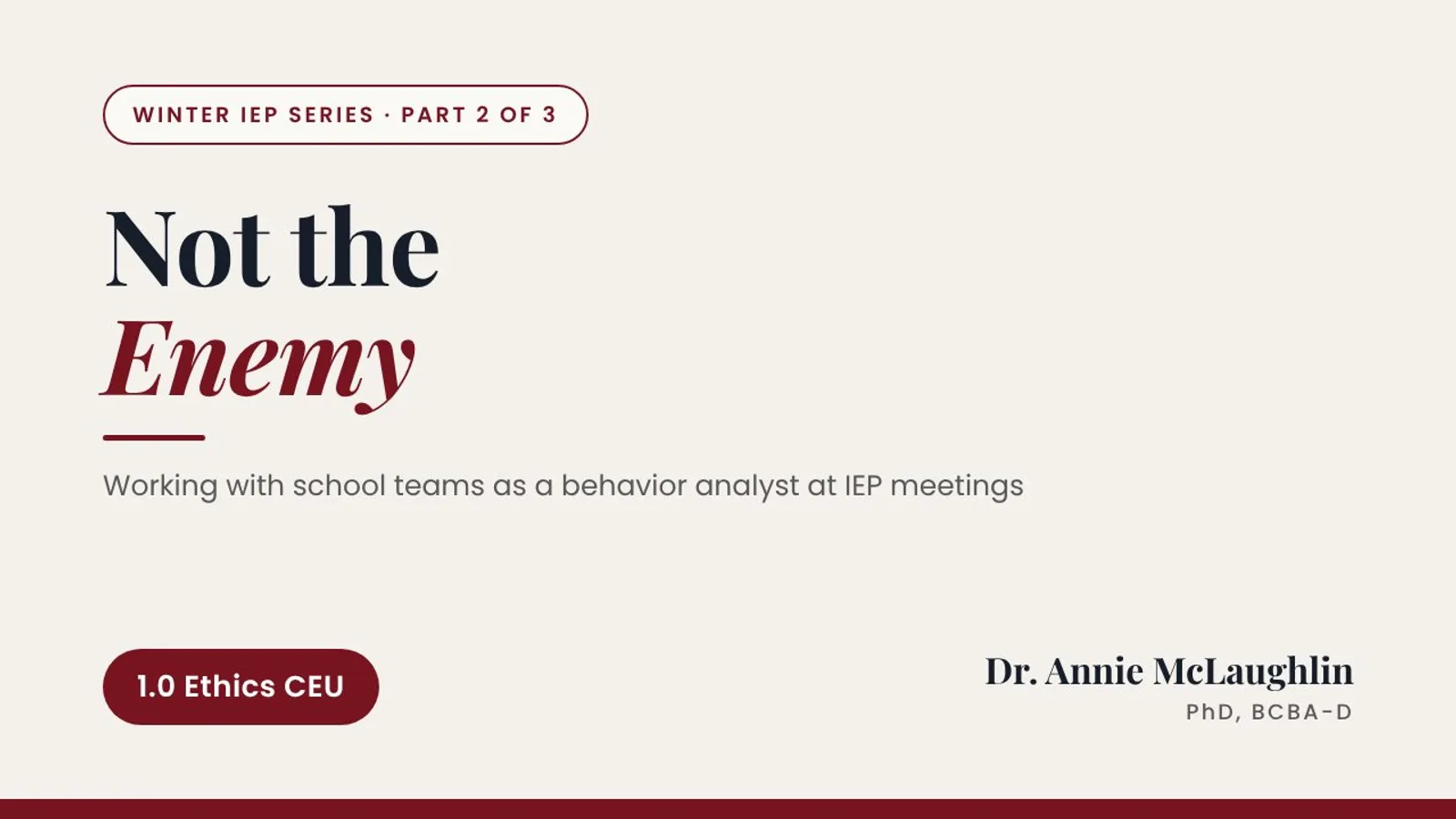
Not the Enemy: Working with school teams as a behavior analyst at IEP meetings
Presented by Constance "Annie" McLaughlin
When
Wed, Dec 9, 2026, 12:00 PM EST
Behavior analysts are increasingly invited to IEP meetings by families, schools, and clinical teams, yet few receive training in how to participate in them. Without that preparation, behavior analysts may stay silent when their expertise is needed, or may make statements that go beyond their data or their scope of competence. Either can damage working relationships with school teams and limit the benefit to the student. This session examines the ethical responsibilities that guide behavior analysts when they communicate concerns and recommendations in an IEP meeting. Participants will practice telling apart concerns that are supported by data from statements that exceed the available evidence or the behavior analyst's competence. They will also practice responding to disagreement with an IEP team that communicates the concern clearly while respecting the perspectives and expertise of other team members. All examples and scenarios are composites and do not describe real students or families.
Attend live and your CEU certificate is issued after the session.
See all upcoming live CEUs →About this CEU
IEP meetings can feel like two sides of the table, with the behavior analyst somewhere in between. Sometimes you are welcomed as a resource; sometimes you are treated like an outsider. In this ETHICS CEU, Dr. Annie McLaughlin looks at how behavior analysts can collaborate with school teams: how to prepare, how to frame recommendations in educational language, and how to handle disagreement professionally and ethically without overstepping your role or going silent.
What you'll learn
- 1Participants will: 1) Identify ethical responsibilities that guide behavior analysts when communicating concerns and recommendations during IEP meetings. 2) Differentiate between data-supported professional concerns and statements that exceed the available evidence or the behavior analyst's scope of competence. 3) Formulate a collaborative, ethically appropriate response to disagreement with an IEP team that communicates the concern while respecting other team members' perspectives.
More from Annie McLaughlin Consulting
OpenCEU is supported by advertising from third-party sponsors. Sponsors are clearly labeled, have no influence over course content, instructors, or CEU decisions, and never appear on certificates. The BACB does not sponsor, approve, or endorse OpenCEU sponsors or their products.