Gaining Assent with your Client
Free · 0.5 PDUs · 4.5★ from 6 attendees
Claim your BACB PD form as soon as you pass the quiz.

Learner ratings
from 6 learners
100% would recommend this PDU to other professionals in their field (6 responses)
Credits
0.5 PDUs · 31 min
From the talk
What was covered
How to read client assent and withdrawal, honor it in the moment, and build sessions clients actually want to join.
- Treat attendance and compliance as neutral: look for an active sign of willingness before you call it assent.
- Learn each client's assent and withdrawal signals, and expect them to change over time.
- When withdrawal shows up, study what happened right before it instead of guessing the reason.
- Ask the teacher what a task actually requires, then trim the demand down to that real requirement.
- Set the first token or first step low enough that the client earns success right away.
- Keep pairing after every hard demand so you never become the signal that aversive work is coming.
What Assent Actually Means in a Session
Assent (showing willingness to join in) sounds simple at first. The speaker framed it as active approval. The word active does the work here. A client who sits in the chair is not giving you assent. A client who finishes the worksheet is not giving it either. You need a sign that the person wants to take part. Someone can dislike a task and still comply with it.
So why track it at all? The first reason is ethics. Assent tells you whether treatment is forced. It tells you whether the client is there by choice. It is also your check that you are doing no harm. And it is how you acknowledge the client's own consent.
The ethics code backs this up. The speaker pointed to code 2.01: do no harm and support the client's best interests. You cannot meet that standard without knowing what assent looks like. For each client, that picture is a little different.
Simply being present or even completing a task isn't telling us to do that.
From the talk — Jasmine Abdel
Assent and Consent Are Not the Same Thing
Consent (formal written approval to treat) comes first. In this field it usually comes from a parent. Most children cannot give legal consent on their own. Some procedures need that written approval on file before you begin. Consent is the big outer frame.
Assent lives inside that frame. It is in-the-moment approval from the person in front of you. The speaker called consent the overall and assent the within. A parent can sign the paperwork, and the client can still say no today. Both pieces matter, and they answer different questions.
The board does define assent in one of its code books. The definition covers vocal or non-vocal behavior. That behavior has to point to a willingness to take part in services or research. It applies to people who cannot give informed consent, by age or by intellectual impairment. The speaker's reason for caring about it was plain. Our clients are human beings.
Everyone deserves to have a voice, so we need to make sure that we're still giving them that ability to have a voice.
From the talk — Jasmine Abdel
Topographies of Assent: What Yes Looks Like
Topography (what the behavior looks like) splits into two groups. Vocal assent is a yes, or any phrase that means yes. The non-vocal group covers more ground.
The non-vocal list from the talk runs long. A nod counts. So does a sign, if the client uses sign language. Pressing yes or start on a communication board or AAC device (a tool that speaks for them) counts too. Leaning in toward you or the materials is a sign. So is smiling, reaching for an item, or taking what you hand over. Walking into the work area counts. So does coming over to sit down with you.
One attendee added a gesture that means come here. That client either makes the gesture or finds the icon on a device. It works as an invitation to come play. Your job is to learn these signals for each client you serve.
So vocal is like saying yes, or an equivalent phrase of approval.
From the talk — Jasmine Abdel
Spotting Assent Withdrawal Before It Escalates
Assent withdrawal (signs they want to stop) is the flip side. The speaker defined it as the learner disapproving of treatment. One attendee described it as unhappiness or discomfort used to pull assent back. Those two words are subjective. They still capture the idea well.
The signals fall into the same two groups. A client may say stop or no. They may make a negative comment about the task. They may change the subject on purpose. Non-vocal signs include signing stop or all done, or touching a picture. Ignoring you or not responding counts. So does leaning away or turning the body away. Some clients swipe materials off the table or throw them. Some engage in self-injury. One attendee described a client who puts their head down and says they are tired.
What you do next matters more than the label. Never assume you know the reason. Look at what happened right before the shift. Then honor what the client told you. Honoring withdrawal teaches the client that communication works. Pushing through it can cause harm. The board has no separate definition for withdrawal, but the do no harm rule still covers it.
they may have been willing a few minutes ago, but they're not willing to do whatever the treatment is now.
From the talk — Jasmine Abdel
Gaining Assent: Start With What You Know About the Person
The speaker sorted the clinical work into three ideas: gain, individualize, and ongoing. Gaining assent starts with knowing the person. Age shapes the picture. So does the severity level of the autism diagnosis. The speaker noted that gender can play a role too. So do the client's preferences.
Illness deserves its own note. The speaker described a client who handles classroom worksheets most days. When that client feels unwell, the same worksheet turns aversive (something the person dislikes). Nothing about the task changed. The person did. Your read has to leave room for that.
You also need to know how the client communicates. Is it vocal or non-vocal? Do they use an AAC device or sign language? And what helps this person feel comfortable with you? Those answers tell you how to go get assent.
The moves themselves are ordinary. Play back and forth, and let the client lead. Try descriptive play (narrating what you both do) when that fits better. Talk about preferred topics with clients who enjoy conversation. Offer choices about the activity, the materials, or the spot. Watch personal space with someone new. You can sit back and play from a few feet away. Then ask if they want to play with you, and wait. A head shake is an answer. So is a yes, and that one lets you move closer.
It's going to be different for every client.
From the talk — Jasmine Abdel
Individualizing Assent by Age, Setting, and Relationship
Age is the first filter. A board game may not gain assent with a four-year-old. They may not understand the rules yet. Building blocks or descriptive play may land much better. You already individualize goals this way. Do the same for assent.
Setting is the second filter. A school is not a clinic. Schools carry their own expectations about what is appropriate. Close physical contact or a client in your lap may not fit there. You also have to work inside the school routine. That means pairing (linking yourself with good things) with the client while the academics still get done. Free play and relaxation time become your best windows for play or conversation.
The stage of the relationship is the third filter. Newer staff see withdrawal sooner and more often. The client leans away because you are still unfamiliar. Years of history change that picture. The speaker has worked with one client for about four years. For that client, the speaker being in the room is now a preferred thing. No activity is needed. Nearness is enough.
And the relationship with the client, that's going to play a big role into their ascent and ascent withdrawal.
From the talk — Jasmine Abdel
Proactive Strategies: Precursors, Expectations, and Easy Wins
Proactive work beats repair work. Start with precursor behavior (small signs before bigger behavior). Rubbing the eyes is one example. A verbal client going quiet is another. These are early drafts of withdrawal. Treat them as data, not as noise.
Next, adjust the expectation while you still can. The speaker gave a school example. During language arts, the task looked heavy on paper. A quick check with the teacher showed the real goal. The student only had to produce the sentence from the board. Tracing it was allowed. Tracing kept the student in the task, with no jump in other behaviors.
Then build in easy wins on purpose. If the client uses a token economy (earning tokens toward a reward), make the first token cheap. Coming to sit at the table can earn it. The client gets success early and praise along with it. The whole situation starts to feel worth joining.
Pairing holds all of this together. Some days you will push a client through something aversive. They will be unhappy, and they will hesitate next time. So you pair again, and again after that. Otherwise you become the signal that hard things are coming. Withdrawal and problem behavior both climb from there.
And so we always need to make sure we're pairing again and again.
From the talk — Jasmine Abdel
Assent Is Ongoing: Daily Checks and the RBT's Role
Assent is not a box you check once at intake. The speaker's third idea was ongoing. Assent runs high some days and low on others. Rest, illness, and mood all move it. So does the number of demands stacked into the day. Two aversive tasks is a different day than six. Proactive moves are how you keep that second day from escalating.
Expect the signals to be quiet. For one client, the whole signal was leaning their head over. Expect the signals to change, too. A head shake in month one can turn into covering the eyes. Or turning the body away. Or dropping the word no altogether. Keep relearning these signals as the client changes.
The speaker offered a useful self-check. Picture a parent watching a video of this session. Would they like what they see right now? That question makes you notice the signal and choose a response.
Most of this work sits with the person running daily sessions. An RBT (the tech who runs sessions) is in the room the most hours. You see transitions, activities, new skills, and off days. You run the plan the analyst wrote. You are the one who reports whether it is working. You also catch changes in how the client communicates. So close the loop with your supervisor. Bring one signal you want to understand better. The speaker said that after four or five years in the field, they are still learning to catch withdrawal earlier.
Cause we only see data, but you guys see everything else.
From the talk — Jasmine Abdel
Common questions
What is assent in ABA?▾
In ABA (applied behavior analysis), assent is active approval from the client in the moment. It is the vocal or non-vocal behavior that shows a willingness to take part. The board defines it for people who cannot give informed consent, because of age or intellectual impairment. Sitting in the room is not enough on its own.
What is the difference between assent and consent?▾
Consent is the formal written approval to treat, and in this field it usually comes from a parent. Assent is the moment-to-moment read on whether the client wants to take part. The speaker described consent as the overall and assent as the within. You need both, and signed consent does not replace a client's yes today.
Does a client completing the task mean they gave assent?▾
No. A client can disapprove of a task and still complete it. The speaker was clear that presence and compliance do not tell you much. You are looking for an active sign of willingness, like leaning in, reaching, smiling, or a clear yes.
What does assent withdrawal look like?▾
It can be saying stop or no, making a negative comment, or changing the subject. Non-vocal versions include signing all done, touching a picture, ignoring you, leaning or turning away, swiping or throwing materials, and self-injury. It can also be very subtle, like leaning a head over or putting it down on the table. The signals change over months, so keep paying attention as they shift.
How do I gain assent with a brand new client?▾
Present many options and watch what happens. An attendee described showing as many choices as possible, then adding more each session and observing the reactions. This shows the client that you are there to play, and it teaches you their preferences and their dislikes. Respect personal space early, and play from a distance until closeness is welcome.
What should I bring to my supervisor about assent?▾
Bring one signal you want to understand better and one question about how to respond. The speaker closed the session with exactly that assignment. If a client has a precursor you cannot interpret yet, name it and describe what happens right before it. That conversation is how proactive plans get built.
About the speaker
Jasmine Abdel led this session on gaining and maintaining client assent. In the talk, they described four to five years of work in the field, including sessions in school and clinic settings and a client relationship of about four years. The session covered definitions of assent and assent withdrawal, vocal and non-vocal topographies, and proactive strategies for keeping assent in place.
This summary was generated from the recording’s transcript. Quotes are taken word for word from the talk.
What you'll learn
- 1Define assent and assent withdrawal and recognize the observable behaviors that indicate a client's willingness or unwillingness to participate in activities or treatment
- 2Identify and implement individualized, proactive strategies to establish and continuously maintain client assent across different ages, settings, and stages of the therapeutic relationship
- 3Recognize potential environmental or instructional factors contributing to assent withdrawal and demonstrate appropriate responses
Related talks
Talks that cover the same concepts
Understanding ADHD: An RBT PDU Series 6: From Session to Real Life: Data, Collaboration & Generalization
ABA Made Ez
Understanding ADHD: An RBT PDU Series 5: Applying ABA Strategies to ADHD-Related Behaviors
ABA Made Ez
Understanding ADHD: An RBT PDU Series 4: The RBT Role: Executive Functioning & Skill Development
ABA Made Ez
Understanding ADHD: An RBT PDU Series 3: Attention, Motivation and Reinforcement in ADHD
ABA Made Ez

Pairing, Rapport, and Instructional Control: Becoming Someone Learners Want to Work With
Hickory Learning Group
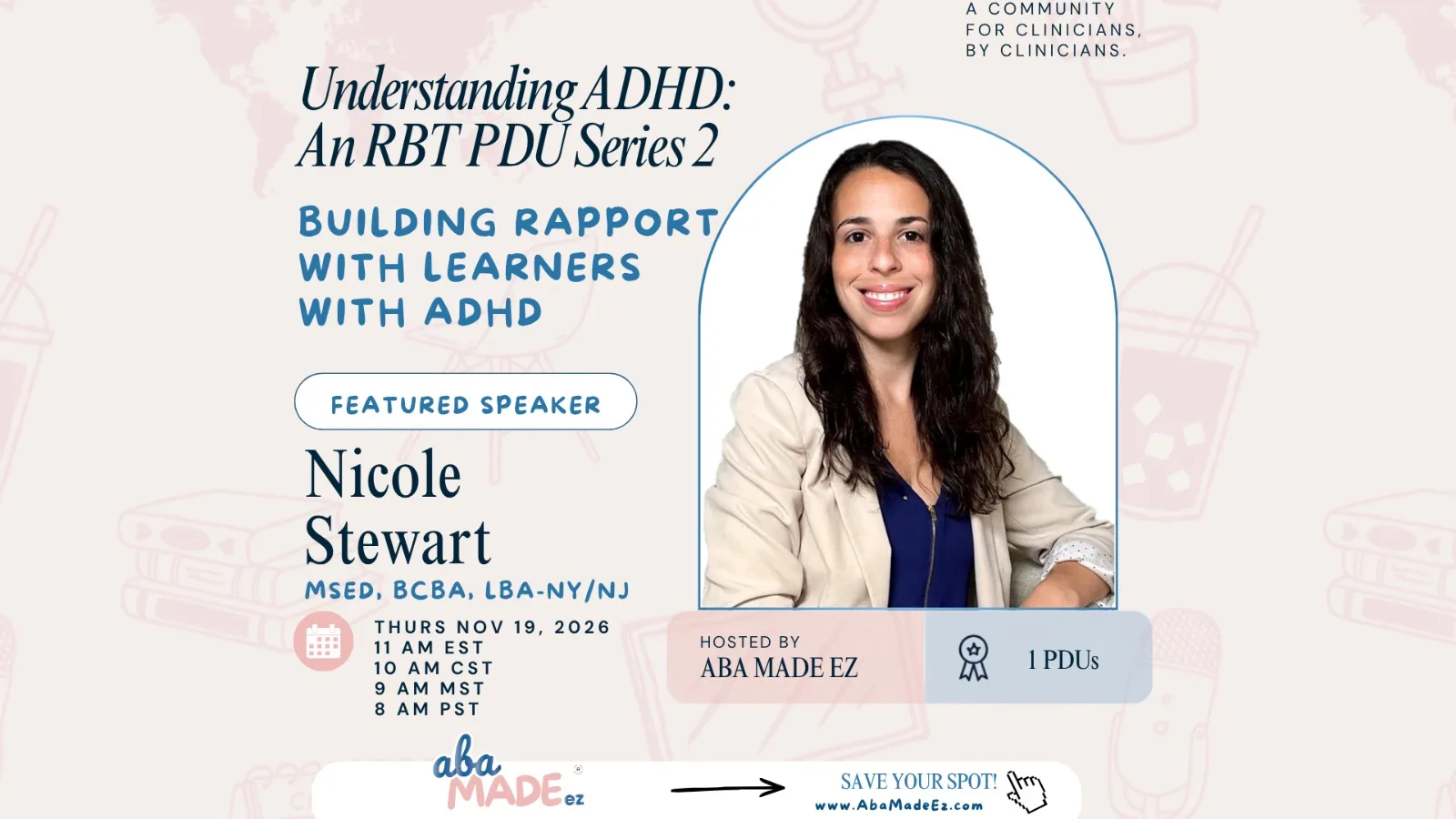
Understanding ADHD: An RBT PDU Series 2: Building Rapport with Learners with ADHD
ABA Made Ez
OpenCEU is supported by advertising from third-party sponsors. Sponsors are clearly labeled, have no influence over course content, instructors, or CEU decisions, and never appear on certificates. The BACB does not sponsor, approve, or endorse OpenCEU sponsors or their products.